
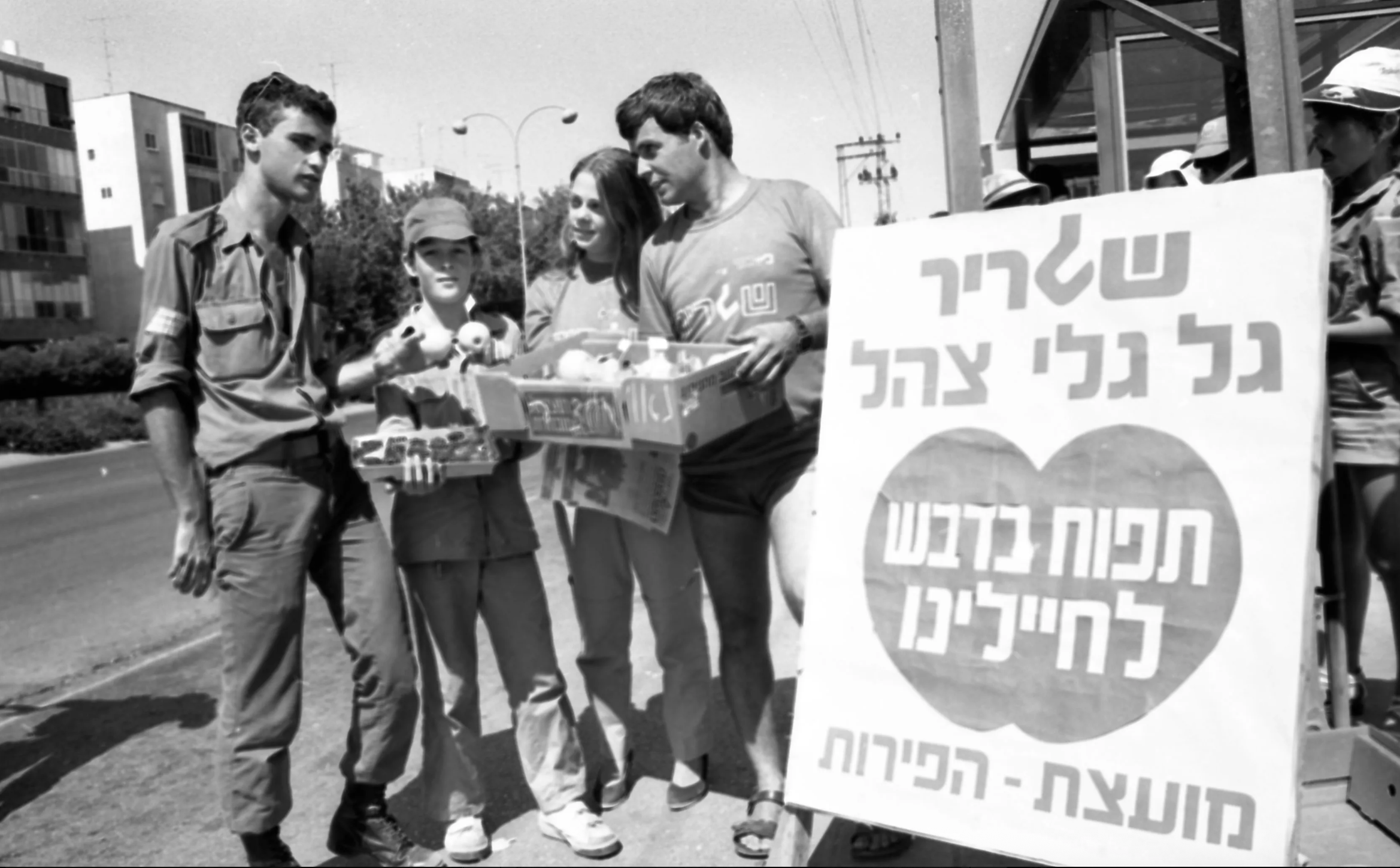
This photograph was taken in 1984 and depicts three young people distributing apples and honey to an IDF soldiers next to a bus stop. The sign reads “Apples and Honey for Our Soldiers” and bears the names of three sponsors of the project: Shagrir, Gal Galei Tzahal, and the Fruit Marketing Board. Shagrir is a car repair business, Gal Galei Tzahal is the army radio station, and the Fruit Marketing Board promotes Israeli fruit. Photo Credit NLI.
To Jump straight to The Why, the When, and the What of the Rosh Hashanah Seder or to Sample Rosh Hashanah Menu
This week, my muse – a combination of a love of Judaism and food – is hiding. I am one of those people that writes every day or thereabouts, not truly believing in a muse, rather ascribing to the notion of hard work over talent. And yet no inspiration has come; my list of subjects to discuss lies unopened. And that is because the movers are here. For those of you who do not know our story, or rather the most recent of our stories, Daniel and I are moving to Australia towards the end of the secular year. Each time I say that it sounds like the beginning of a joke, but the joke just got serious. Our stuff will be going into storage while Daniel and I finish up here in London until the middle of the Sukkot festival. Then we will go to Israel to spend time with our family while awaiting our visa and then about three months from now we will, with God’s help and the visa office’s permission, reach Melbourne. So as inspiration hasn’t hit, trepidation has.


With that all in mind, as I realize that September is upon us, so are the High Holy Days, which means that in my calendar it’s time to discuss Rosh Hashanah food and its symbolism. Putting aside moves and anxiety, while the packers do their thing, I will do mine and tell you a bit about the Rosh Hashanah Seder!
As a little girl the whole family descended on my grandparents’ two-bedroom house in Forest Hills for the Chagim, especially Rosh Hashanah. My grandparents’ table always had an array of food served on mismatched plates. I don’t think my grandmother ever considered appetizer a thing. Perhaps soup was served before other things, but in general we went straight into the meal. I don’t think Savta (grandmother in Hebrew) thought in terms of side dish vs. main. The only categories she ascribed to aside from the meal was something sweet at the end. That is why Rosh Hashanah stood out: in my grandparents’ home there was a Rosh Hashanah seder, served before the main meal on the first night of Rosh Hashanah. The practice has become much more widespread in the last thirty years, but back then I didn’t know anyone else who did this. And back then the foods that made up my grandparents’ Rosh Hashanah seder were not easy to come by in NY.

I have written in the past of how the NY of the 1970s and 80s was not a cosmopolitan food treasure chest by any means. My Savta would pick up date spread in Israel. The black-eyed peas she sourced in the shops that specialised in the food of the American South, the Swiss chard from the newly emerged health food shop, and the pomegranate, sold sparingly and at great expense, came from California.
As the only grandchild who had the patience to do it (though my grandmother told me it was because I had small fingers), it was my job to pick each and every seed out of the pomegranate. The single pomegranate was too dear to bash over the head as we do today in order to expel its seeds.
Back then, while the men were at the evening prayers at the small synagogue up the block and on the other side of the road from my grandparents, I would sit at the kitchen table, narrowly avoiding suffocation by Savta’s housecoat – this article of clothing was meant to keep clothing safe from the blood-red pomegranate juice as I gently pried each and every seed out of its white casing.
Then, all at once, the men were back. My grandparents combined their Ashkenazi and Sephardi traditions at the table to create something uniquely ours as a family. And the Rosh Hashanah seder would proceed, reciting blessings for ourselves and curses for our enemies as we tasted each of the exotic and familiar foods at the table.
To me this has been, and will always be, what Rosh Hashanah is about: family around a table – a table filled with love and hope for the future; where, in modern terms, we were manifesting our year ahead, praying for the good and punishing the bad.
The Why, the When, and the What of the Rosh Hashanah Seder
Some of the foods from the Rosh Hashanah seder have become all too familiar, so that they no longer elicit excitement. The pomegranate, the dates, and Swiss chard are available to me year-round and I use them all the time. On the other hand, the black-eyed peas are still a bit unusual. But what still makes the Rosh Hashanah seder unique, when all these foods are now so easy to come by, is the seder – meaning “order” in Hebrew. We eat each of these foods in a specific order and say a blessing over each one. This is something that is only done on Rosh Hashanah in this way, and it holds power and promise. We are using the heavens (if you believe in this sort of thing, stay with me – if this is not your thing you are welcome to mock – just quietly please!) which are open to us during Rosh Hashanah, when the God of mercy is listening, and the foods are meant to inspire us to pray for the things we need.

The sages who put together these blessings were concerned with two things: first and foremost that we are blessed to live a good life, and second that our enemies do not bother us – and better yet disappear. Two and a half millennia later we are still asking for the same thing. So this here is your two-week heads-up: if you haven’t ever done a Rosh Hashanah seder, consider it, and if you have done it, keep it up!
Consider Rosh Hashanah for a moment. Consider the things that spring to mind: apples and honey, shofar, round challahs, pomegranates, prayer.
Rosh Hashanah, unlike the Foot Festivals (the Shalosh Regalim: Sukkot, Pesach and Shavuot), does not celebrate a part of the history of the Children of Israel, nor is it the celebration of a particular agricultural milestone, as the other festivals in the Torah (aside from Yom Kippur) are. Rosh Hashanah and Yom Kippur are festivals about our relationship with our fellow man, our relationship with the world we live in, and ultimately our relationship with God. Almost everything we do is symbolic, from what we read in the Torah, what we wear, what we eat and what we don’t eat. The Talmudic sages, understanding the power of the experiential practice throughout Judaism, and thus they tell us that to eat certain foods on the eve of Rosh Hashanah – namely beans, leeks, beets, dates, and pumpkin – is an auspicious thing to do.
Later rabbis added other foods: the 14th-century Spanish kabbalist Abudarham of Seville adds pomegranate to the list, and the Tur (Rabbi Jacob ben Asher of Toledo, 14th century) adds apple dipped in honey. The Levush (Rabbi Mordechai Jaffe of Prague and later Poland–Lithuania, 16th century) notes an old Ashkenazi custom of dipping challah in honey on Rosh Hashanah.
The rabbis see no issue whatsoever in piling symbols upon symbols to the Rosh Hashanah meal. In a religion that is dense, we are cautious of adding more, so this is a bit of an anomaly. But on the other hand, is it? Rosh Hashanah is similar to the secular New Year’s (perhaps it’s the other way around?). Though it may be just another date in the calendar, it feels like so much more, aside from the mystical belief that it is easier for us to access God at this time of year, there is the weight and pressure we put on ourselves: to turn the page, to close a book and open another. Perhaps to write our own. And the rabbis see that as a positive: that while we are inclined to welcome in the new, we should welcome it using blessings and symbols so those blessings are reinforced not just by word but by deed.
If the Rosh Hashanah seder was ubiquitous in Talmudic times, why did so few people know about it until recently?
The first thing to note is that it isn’t a commandment, and it isn’t even so strong a custom that it is nearly law, like other customs that come up around other foods (such as Kitniot). It always was, and remains, a nice thing to do.
For the Jews of Europe, far from where the Bible and Talmud were written, some of the foods were simply not available. While some people replaced them with other foods, like carrots for one of the blessings, most were simply not available, so the practice died down. My grandparents kept the custom, my grandmother because she was Sephardi, and though my grandfather was Ashkenazi, his family had been living in Jerusalem since the early 1800s and the Ashkenazi Jews of Jerusalem reintroduced the Rosh Hashanah Seder as soon as the foods were once again available to them.
Hence the directive from the rabbis that you can create your own symbolic foods or your own play on words. Don’t take away the old ones – unless the food is unavailable – just add new ones, build on the foundations of the five foods the rabbis discuss in the Talmud, and add more, like the pomegranate, the apple, and the honey. Here is the list of symbols (known as the “Simanim”) as a PDF which you can print, as well as a few recipes that are delicious and will make each siman more than a raw carrot or leek!
Good luck with your Rosh Hashanah preparations!


- Wine
- Challah
- Glazed Carrots (Simple Tzimmes)
- EJEH – Swiss Chard Frittata
- Beetroot and Balsamic Vinegar
- Zucchini and Shallot Crumbs
- Black-Eyed Peas in Tomato Sauce
- Meal
- Chicken Soup
- Pomegranate Slow-Cooked Lamb
- Ginger and Honey Chicken
- Noodles and Cabbage
- Roasted Sweet Potato & Pear Salad
- Green Beans with Cherry Tomatoes
- Evelyn Schiff’s Honey Cake
- Fruit
One response to “The Rosh Hashanah Seder – Memory, Meaning, and Blessing”
What about leak patties? I love the picture with the simanim platter.