
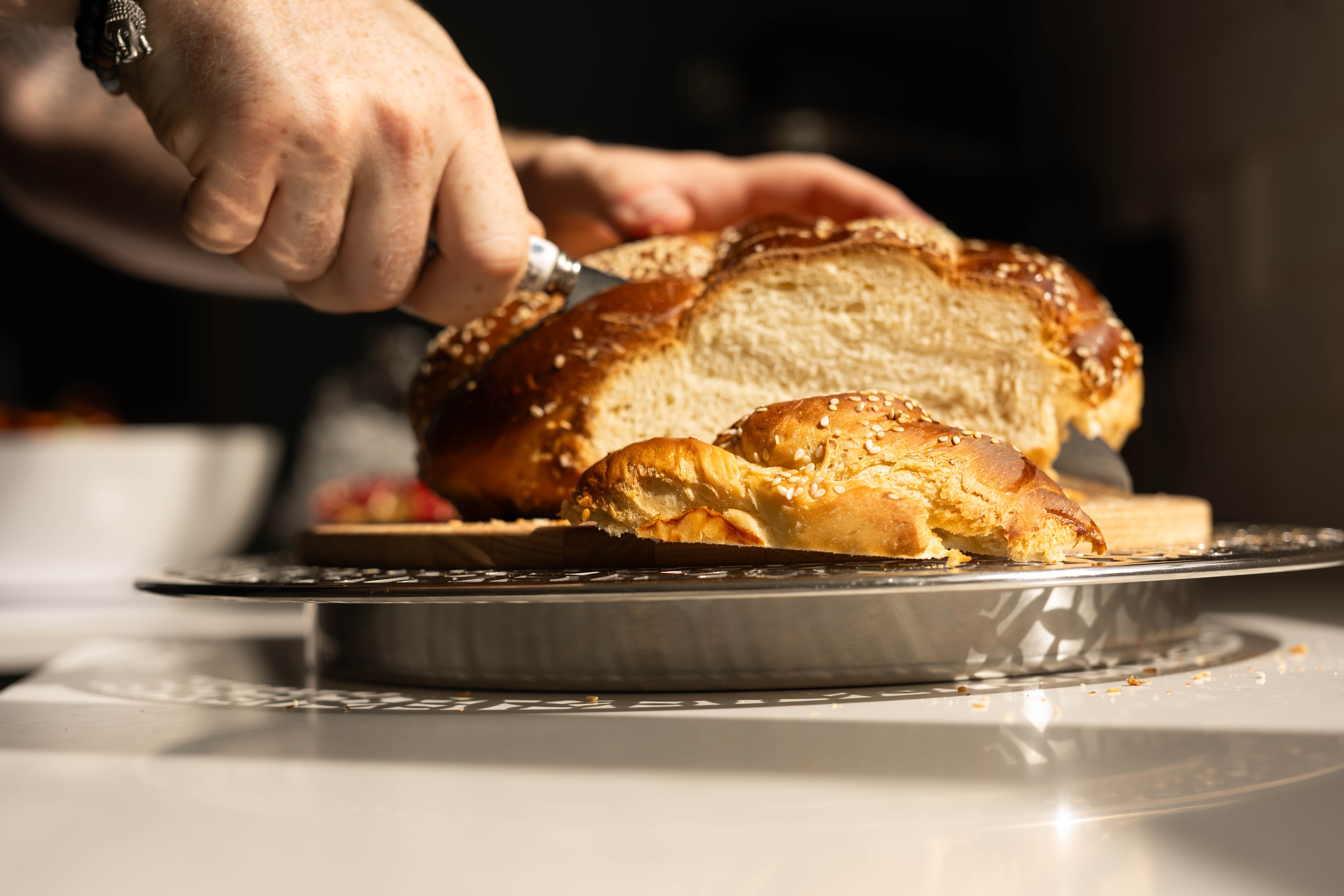
This Challah recipe is perfect, and I can say that as it was gifted to me by master Chef Claude Ben Simon. It just works. I get a lot of questions about challah, what it is, and how to make it, and most importantly, how to get it right.
Creating challah is a process that combines simplicity of ingredients with the magic of yeast and time. To achieve the ultimate Shabbat loaf, it is important to exercise patience. A few key tips for challah baking:
- Embrace the Basics: Challah is made from humble ingredients like flour and water, yet the way you manipulate and bring them together elevates it to a luxurious loaf. Remember to appreciate the beauty in simplicity.
- The Power of Yeast: Yeast is an essential element in challah baking. Ensure that it is fresh and active.
- Time as an Ally: Don’t rush the process. Give the dough enough time to rise properly. This will result in a lighter and fluffier challah.
- Kneading with Care: Take your time when kneading the dough. It should be smooth, elastic, and slightly sticky. Don’t be afraid to add a little extra flour if needed, but be cautious not to add too much, as it can result in a dense texture.
- Shape with Creativity: Challah offers endless possibilities for shaping and braiding. Let your imagination run wild, whether it’s a classic three-strand braid or an intricate woven design. Experiment and have fun with it!
This recipe is simple to work with and can be easily halved or doubled.
INGREDIENTS:
Makes 6 medium challahs
- 1,660g (3.66 lbs/ 13 1/4 cups) strong white flour
- 180g (3/4 cup + 2 tablespoons) granulated sugar
- 35g (1/4 cup) active dry yeast
- 30g (3 tablespoons) salt
- 90ml (6 tablespoons) oil
- 2 large eggs, lightly beaten
- 750 – 1000ml (3-4 1/2 cups) water
Egg wash:
- 1 egg lightly beaten
- 1 tablespoon water
METHOD:
- Mix the dough: In a large bowl, mix together the flour, sugar, yeast and salt. Make a well in the centre and add the oil and eggs along with 750ml (3 cups) of the water. Add more water as needed. Knead the mixture inside the bowl several times until you have a cohesive dough with a few floury spots. Turn the dough out onto a floured work surface and knead until smooth (about 8–12 minutes), adding more flour to the surface to prevent sticking.
- Let the dough rise: Place the dough in an oiled bowl, covered tightly with plastic wrap or with a damp towel, and let it rest for about an hour, but up to two depending on the ambient temperature, until doubled in size.
- Alternatively: the dough can be refrigerated for up to 12 hours.
- The dough is risen when pressed lightly with your finger—the dough should feel very airy and spring back, holding a slight impression.
- Take challah: Remove an egg-sized portion of dough from the risen mix, if separating for challah blessing.
- Divide and shape: Cut the dough into 18 portions, each about 150 g. Roll each piece into a long thin rope about 35–38 cm (14–15 inches) long, and braid/plait as desired.
- Let rise again: Place the braided challahs on a baking tray lined with parchment paper, spacing them at least 5 cm (2 inches) apart. Cover and let rise again for 45–75 minutes, until puffy. (If the dough was refrigerated, this step may take an additional 30 minutes.)
- Prepare the egg wash: In a small bowl, combine the beaten egg with a tablespoon of water.
- Bake: Brush the challahs with egg wash. Bake at 180°C (350°F) for about 35–40 minutes, rotating trays halfway through. The challahs are ready when they are golden brown and sound hollow when tapped on the bottom.
MAKE AHEAD:
Challahs can be baked ahead of time. Allow to cool completely before wrapping in aluminium foil. Can be frozen for up to 1 month. Defrost completely before serving.
4 responses to “Challah”
[…] and Challah (my Mom recently started making challah – more on this next week, but for now she had an […]
[…] Wine and Challah […]
[…] Challah Glazed Carrots (Simple Tzimmes) EJEH – Swiss Chard Frittata Beetroot and Balsamic Vinegar Zucchini (Courgette) and Shallot Crumbs Black-Eyed Peas in Tomato Sauce Chicken Soup Pomegranate Slow-Cooked Lamb Ginger and Honey Chicken Noodles and Cabbage Green Beans with Cherry Tomatoes Evelyn Schiff’s Honey Cake […]
[…] The onions bring a natural sweetness, the balsamic adds a gentle tang, and the mayonnaise ties it together into a creamy, moreish spread that pairs beautifully with challah. […]