
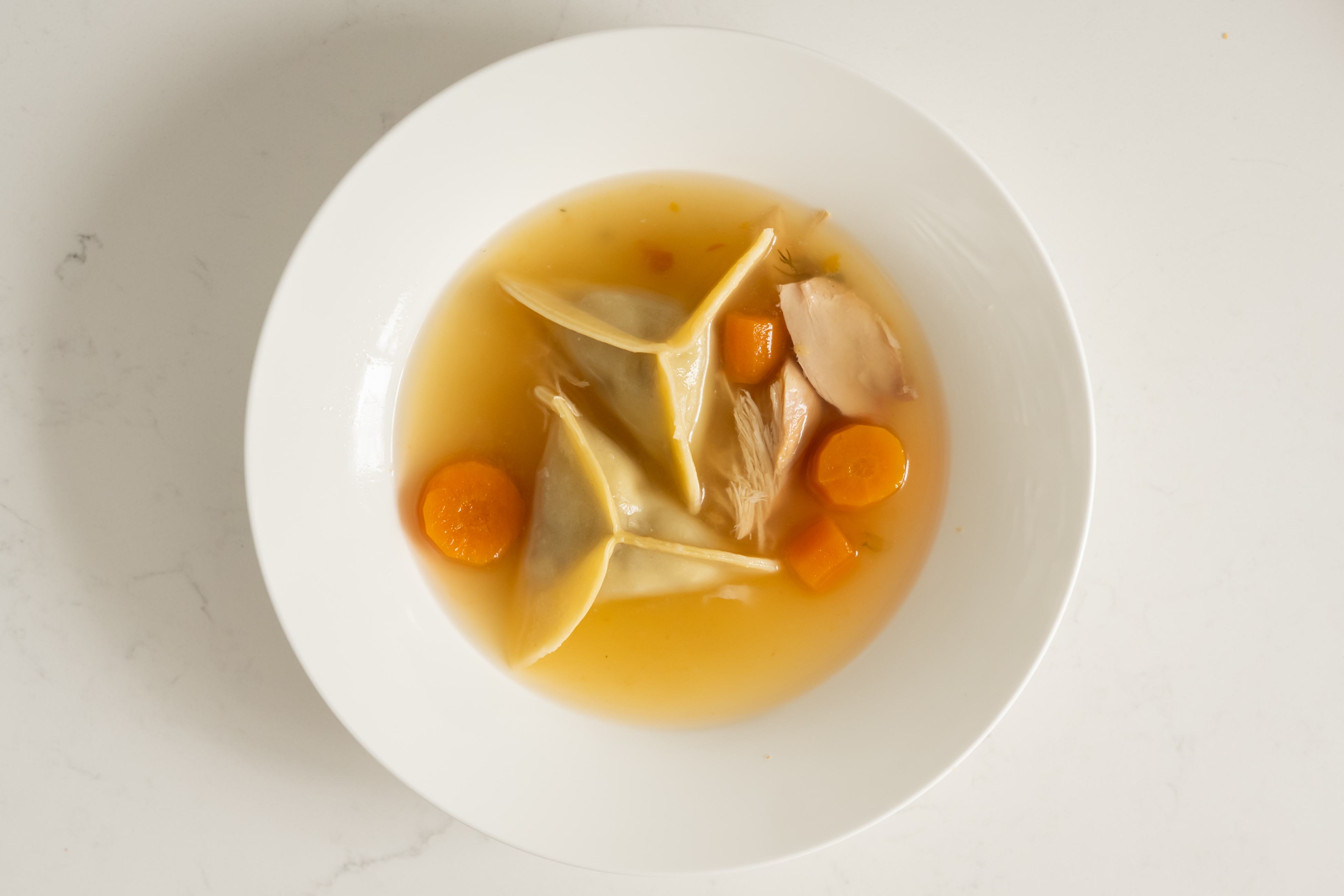
Around the 16th century, Eastern Europeans started making filled pasta; probably the influence of both the Tartar invasion from Asia in the East and Italy in the South. Regardless, this was innovative. As hard as it is for us to imagine, it hadn’t occurred to the people of Northern Europe to boil their pasta; they were frying it up to this point. Boiling, as opposed to frying in fat, was far cheaper, and from that point forward boiling pasta – both filled and unfilled – became a mainstay of Northern and Eastern European cooking.
Kreplach, a meat-filled pasta, became a much-beloved Ashkenazi dish. Though noodle making was a weekly occurrence in most Jewish homes, it was time-consuming. Kreplach, which involved making pasta and filling as well as shaping, was even more time-consuming, thus saved for special occasions such as lifecycle events and holidays.
The three times of year most associated with Kreplach were the meal just before the fast of Yom Kippur, Hoshana Rabba – the seventh day of Sukkot – and Purim. On all three of these days, we are meant to feel God’s love and protection enveloping us as the dough envelops the filling of the kreplach.
The traditional way of making Kreplach involved rolling by hand. Thus, oil was added to the pasta dough to help in the rolling process. Not only is our flour finer but using a pasta machine for the rolling means that the process should be far easier than using a rolling pin.
INGREDIENTS: Yields 18-20 kreplach
For the filling:
- 1 tablespoon vegetable oil
- 1 small onion, peeled and finely chopped
- 250 g (8 ounces) ground beef
- Salt and pepper, to taste
For the dough:
- 3 cups (375 g) plain flour
- 3 large eggs
- 1 tablespoon vegetable oil
- 1 teaspoon salt
- 1–2 tablespoons water, as needed
METHOD:
- Cook the onion: Heat a large sauté pan. Once hot, add the oil and heat until shimmering. Add the onion and sauté until golden brown, about 7 minutes.
- Cook the beef: Add the ground beef to the pan and cook until browned all over. Season with salt and pepper. Remove from heat and allow to cool completely before using to fill the kreplach.
- Make the dough: Place the flour and salt in a large bowl. Add the eggs and oil, then mix until a rough dough forms. Add water, 1 teaspoon at a time, until the dough comes together. Knead until smooth and elastic, about 10 minutes. Wrap tightly and rest for 30 minutes.
- Roll out the dough: Divide the dough into 4 pieces. Using a pasta machine or rolling pin, roll out thin sheets (to about setting 6 on most pasta machines).
- Cut the dough: Cut out as many 9 cm (3.5 inch) circles or squares as the dough will provide.
- Fill and shape: Place one heaping teaspoon of filling in the centre of each circle or square. Dab the edges lightly with water and shape into a triangle (fold in half diagonally if using a square, or fold three sides inwards if using a circle).
- Store the kreplach: Place filled kreplach on a well-floured board and covered. They can be stored in the fridge for up to 2 days or in the freezer for up to 1 month, freeze in single layer once fully frozen, place in an airtight container.
- Boil the kreplach: Bring a large pot of salted water to a boil. Add 5–6 kreplach at a time and cook for 3–4 minutes until the pasta is cooked through. Remove with a slotted spoon and drizzle lightly with vegetable oil to prevent sticking. Repeat with remaining kreplach.
- Optional sauté: To sauté, heat oil over medium flame in a large skillet. Add the boiled kreplach and sauté until golden brown on both sides.

MAKE AHEAD:
Store the kreplach: Place filled kreplach on a well-floured board and covered. They can be stored in the fridge for up to 2 days or in the freezer for up to 1 month, freeze in single layer once fully frozen, place in an airtight container. If you have frozen your kreplach, do not defrost. Cook directly from frozen, adding 1 minute to the cooking time.