
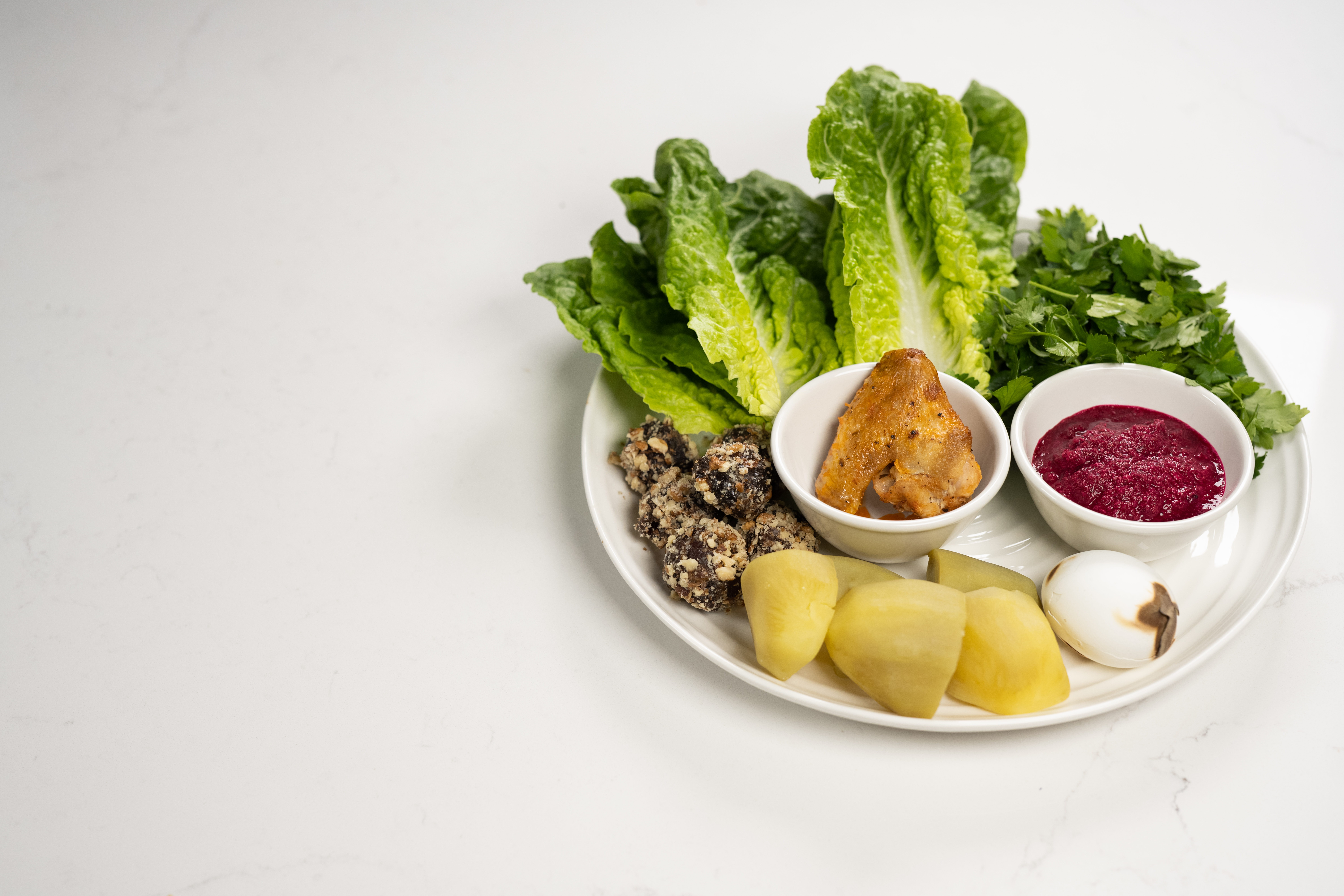
& Seder Essentials
As many in the Jewish world gear up for Pesach, I’m also preparing for the March of the Living . I’m beyond privileged to be joining March of the Living UK this year as an educator, and I’m sure I will be sharing more about the experience. For now, though, as I simultaneously prepare for both Pesach and the March (and frankly, because my interests are split, I’m failing at both), today, I decided to marry the two.

The Holocaust didn’t happen over a day, a month, or even a year. From September 1939 to May 1945, throughout Europe, Jews were in this nightmare for five Pesachs. Whether in forests, in hiding, in ghettos, in camps, or for the fortunate Jews on the Allied side but still fighting a war, the lengths each went through to celebrate Pesach in some way, to bake matzah, were extraordinary. And the question to me is always: why? In the midst of hell, how did they find the will to celebrate redemption? Why did they bother? Why, in many cases, did they risk their lives to celebrate the holiday that commemorates God as the salvation of the Children of Israel while millions of Jews were dying all around them?

The most stark of these examples is Pesach 1943 in the Warsaw Ghetto. As the German tanks were rolling in to put down the ghetto uprising, testimony after testimony related that the fighters put down their makeshift weapons to celebrate Pesach, even if only for a moment.

There are a number of stories of the lengths that people went through in the camps in order to secure the flour and the fuel needed to bake matzah (story from chabad.org), with every single step involving risking their lives. What stands out to me is that although we know the stories of those who survived risking their lives to bake matzah, we don’t know of stories of those who risked their lives but whose risk did not pay off. Jewish law does not actually condone what these incredibly brave men and women did. Judaism does not condone risking your life to bake matzah. And in a few of the stories connected to matzah, it is learned, pious people who were at the helm of the matzah-making initiatives. Surely they knew that matzah-making was not necessarily commanded in such life-threatening circumstances? How do we explain the incongruity of this? Not just the philosophical idea of matzah baked to celebrate a holiday of Jewish freedom, while every moment could have brought the angel of death who in this case was killing Jews, not the famed goat of Pesach, so why risk life especially when Jewish law would not condone the act?

I think in places where there was no hope, where the very act of being a Jew wasn’t just illegal, it was life threatening, was the very moment that matzah-making, seder-celebrating Jews chose to embrace their Judaism, not abandon it. That they found in the task of making matzah another reason to live. The very act of sitting at a seder table, of eating matzah, has been one of the secrets of our continuity. That every single year, from generation to generation, we tell the story – not just of our affliction but also of our survival – is something that gives us hope in our day and age. How much more so in the midst of the living nightmare that was the Holocaust?

There is a photo that survives from the Łodz ghetto of a small group baking matzah in 1943. What is extraordinary about this image is the detail. Though a lot of focus is put on the Warsaw ghetto, there were over 1000 ghettos in Nazi Europe, and Łodz was considered one of the worst. Not only did it last the longest, but some of the worst abuses and stories of deprivation come out of the Łodz ghetto. And yet this group of five plus the photographer (and who knows if there were others in the room that looks like a cellar) risked everything to make matzah. The oven seems to be underground, and the women and one of the men secured white coats to cover up their clothing. This ensured that their clothing that may have had some chametz on it didn’t somehow taint the matzah. One man seems to be inspecting the matzah; he speaks to the baker who holds a long dowel. Draped over the dowel are three matzahs waiting to go into the oven. The baker looks directly at the photographer; to me, his look is unreadable. But the person who we can read is the woman in the center; she seems to be looking either at the photographer or directly past him, and she is smiling and she looks happy. it’s a small moment of joy in the midst of everything. I wonder if it is for that small moment of joy, of celebrating the tradition of her ancestors, or was it someone in the background that made her smile. Regardless, for that moment, she looks happy. I don’t know if any or all of the people in the photo survived the war, but this seems clear: for the few seconds while the camera snapped the picture, the woman smiled, and that smile, I hope, sustained her, the way she is sustaining us.
Things are not easy at the moment. They are nowhere near as hard as they were then, but let’s not kid ourselves; they are not easy. That said, I hope we will all be able to have matzah this year, celebrate who we are and the traditions that have sustained us not just in times of happiness but also in times of challenge.
As we are sharing difficult though important ideas, here is a Passover poem by Auschwitz survivor Primo Levi:

Passover by Primo Levi
Tell me: how is this night different from all other nights? How, tell me, is this Passover Different from other Passovers?
Light the lamp, open the door wide, so the pilgrim can come in, gentile or Jew;
Under the rags, perhaps the prophet is concealed.
Let him enter and sit down with us; let him listen, drink, sing, and celebrate Passover; let him consume the bread of affliction, the Paschal Lamb, sweet mortar, and bitter herbs.
This is the night of differences, in which you lean your elbow on the table, since the forbidden becomes prescribed, evil is translated into good.
We will spend the night recounting far-off events full of wonder, and because of all the wine, the mountains will skip like rams.
Tonight they exchange questions: The wise, the godless, the simple-minded, and the child. And time reverses its course, today flowing back into yesterday, like a river enclosed at its mouth. Each of us has been a slave in Egypt, soaked straw and clay with sweat, and crossed the sea dry-footed.
You too, stranger. this year in fear and shame, next year in virtue and in justice.
Seder Essentials:

Though I have shared most (but not all) of these recipes before, they are tested and wonderful and easy and the recipes I come back to time and again, wholesome and comforting is the best way to describe this classic seder menu:
- Seder Plate Essentials
- Savta’s Charoset or Charoset Balls
- Chicken Soup
- Matza Balls
- Aunt Eudices Brisket
- Braised Chicken with Tomato and Basil
- Roast Potatoes with Shallots and Thyme
- Braised Courgettes/Zucchini
- Glazed Carrots – Simple Tzimmes
- Lettuce Salad
- Strawberry and Rhubarb Compote
- Chocolate Mousse


