
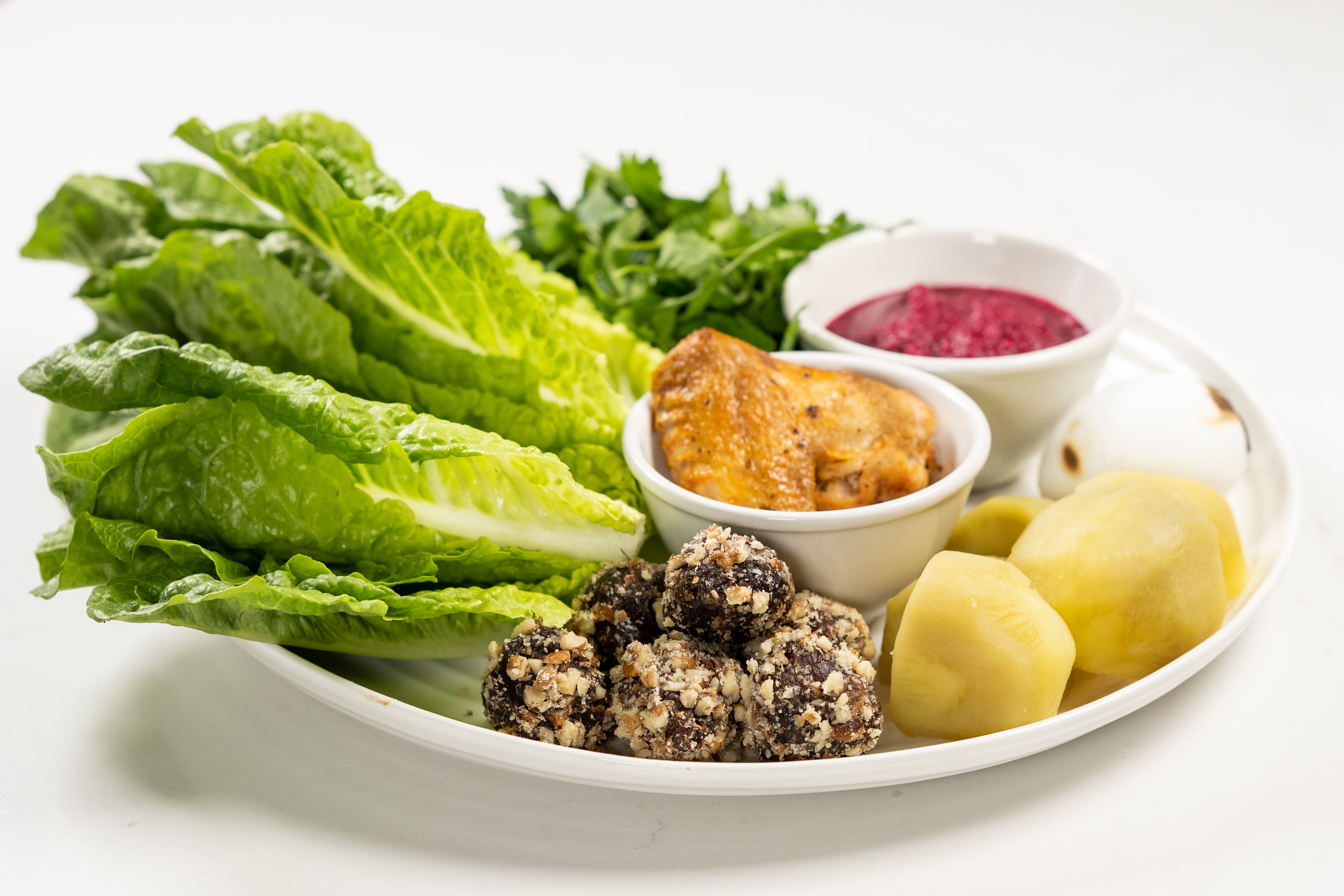
There are at least five foods (though really it’s six) that go on the Seder plate:
- shank bone (zeroa)
- egg (beitzah)
- bitter herbs (maror)
- vegetable (karpas)
- sweet paste called charoset
- Many Seder plates also have room for a sixth, hazeret (another form of the bitter herbs).
All of them are meant to remind us of the primary theme of Passover: the Jewish people’s transition from slavery to freedom. There is generally only a small, symbolic amount of food on the Seder plate, with additional dishes of karpas, maror and charoset set out for people to eat from during the Seder.
I have often rejected the traditional Seder plate with its grooves, instead I often use a large round platter, piled high with everything we need for the Seder. The reason was that when we first got married, we didn’t have a Seder plate and over the years, I couldn’t find one that reminded me of the large brass platter my Savta used as a makeshift Seder plate. Though knowing that many people love the traditional Seder plate, I mix and match.
The tradition in our home is that when people return from evening services the first night of Pesach, they are meant to ‘build’ their own or their family’s Seder plate. I lay out all the needed items and a stack of plates; some are just large round plates and others are the traditional Seder plate with its grooves, allowing each person to choose what they prefer. Any of the Seder plate foods that don’t make it onto the individual Seder plates are then placed in the center of the table as top-ups.
What does each food on the Seder plate symbolize?
- Shank bone (zeroa): This is a roasted bone with some meat on it. Although zeroa is often described as the shank bone of a lamb, other bones work too – such as a chicken wing, chicken leg, or part of the neck. The emphasis is on the commemoration of the Pesach sacrifice, which was the most important part of celebrating Pesach in the time of the Temple in Jerusalem.
- Egg (beitzah): The egg commemorates the ‘Hagigah’ sacrifice that was eaten with the Pesach sacrifice on Seder night during Temple times. It would have been an animal, not eggs, that was brought to the Temple. It is suggested that we use an egg because it represents the cycle of life, and eggs are typically mourner’s food, reminding us that we are mourning the destruction of the Temple. As a result, we cannot bring the Pesach sacrifices. The Seder plate egg is traditionally boiled and then charred. The Seder plate egg is different from the hard-boiled eggs that many have a custom to eat with salt water once it’s time for the meal to begin.
- Vegetable (karpas): Almost any vegetable may be used for karpas, as long as it’s not one that can be used for bitter herbs. The vegetable can be served cooked or raw, whichever is the normal method of eating it. Vegetables that are commonly used for karpas include parsley, celery and potatoes. During the Seder, the karpas is dipped into salt water before eating, reminiscent of the tears of the Israelite slaves
- Bitter herbs (maror): Mar means “bitter,” and the maror reminds us of the bitterness of slavery. The two main foods customarily used for maror are lettuce – especially Romaine lettuce (wild lettuce used to be incredibly bitter and the Mishnah lists it as one of the five foods that can be used for maror) – and grated horseradish.
- Hazeret (another form of the bitter herbs): Think of the second form of bitter herbs – hazeret – as double bitterness. Horseradish became a popular choice for maror because it was easier to obtain than lettuce in Germany and Eastern Europe.
- Charoset: The word is thought to come from the Hebrew word ‘heres‘, meaning “clay,” and the sweet paste symbolizes the clay the Israelite slaves used to make the bricks and mortar for the Egyptian overlords. As our freedom offsets the taste of remembered slavery, the sweetness of charoset offsets the taste of the bitter herbs. There are many different recipes for charoset. Ashkenazi versions often include apples, walnuts, and red wine, while many Sephardi charosets include dates, walnuts, and wine. Here is my Savta’s recipe, and here is my updated version of charoset balls that use more modern flavours and are also great eaten after Seder as a snack.
One response to “Seder Plate”
[…] Seder Plate Essentials […]