
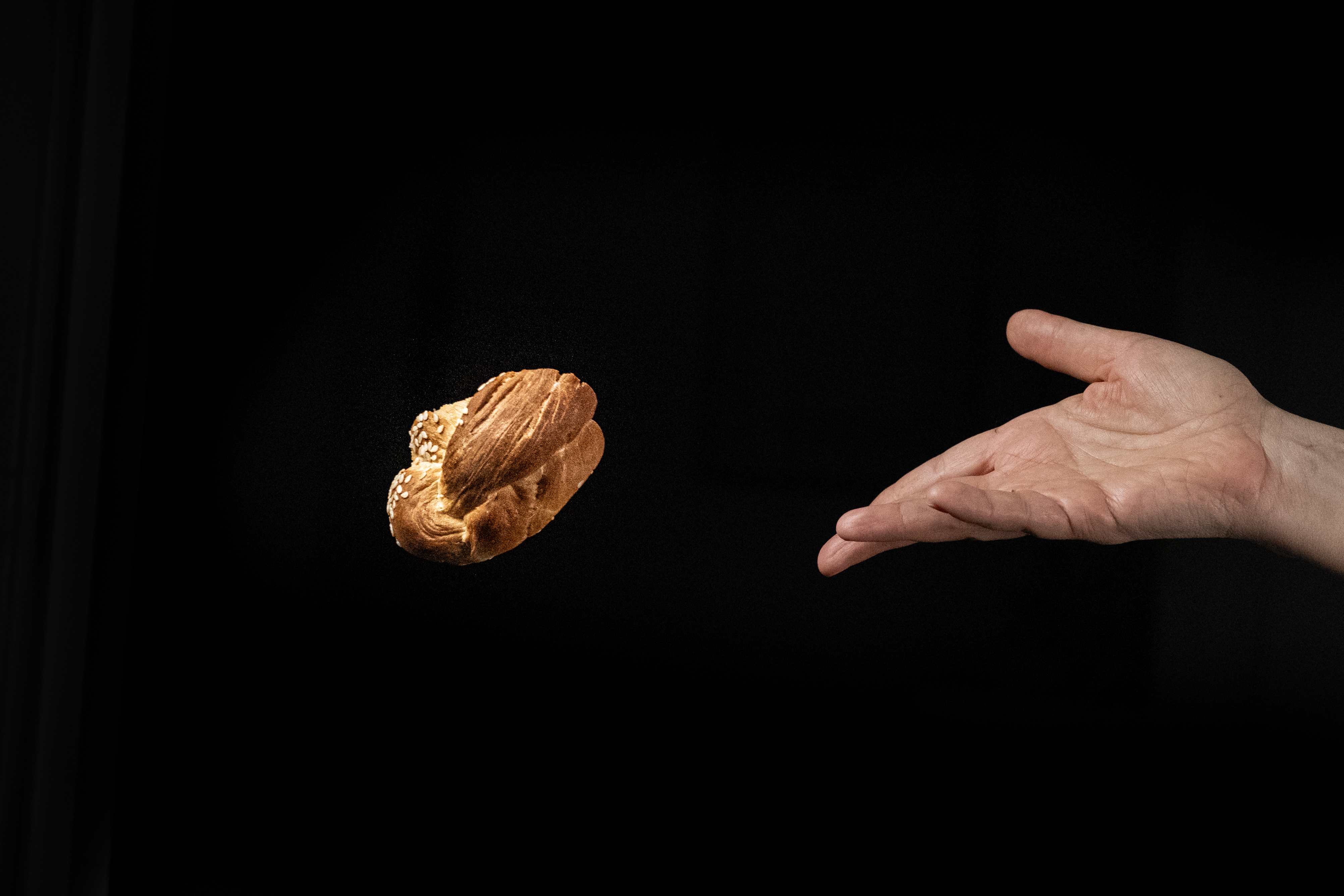
Enjoy the amazing photo by the one and only Blake Ezra
There is a Jewish belief that we can do positive commandments and teach Torah in honor of another person, so that our prayers on their behalf are answered. This week I will be making challah, and in my prayers will be my cousin Ari Spitz, who has been seriously injured in Gaza. If you too would like to do a positive deed, say a prayer, or make challah with a blessing for the merit of Ari’s full and speedy recovery, his Hebrew name is Moshe Aharon ben Leah Bayla.

Since October 7th, 2023, I have used this platform as my therapy, as the place where I can dig deep and express all the thoughts and emotions that have been a constant burden on my psyche. How does one walk through this world when they feel so much?
Initially, on social media, there was a post stating that your Jewish friends are not okay. No, we really are not okay, and we haven’t been okay in a very long time. Instead of giving you a list of how not okay we are at the moment, I will teach, as that is one of the purposes of me as a person in this world and for us as Jews. This is my positive deed on behalf of the speedy and full recovery of my cousin Ari Spitz.
The History of Challah part 1:
Challah is the bread we all associate with Shabbat (so ubiquitous with Shabbat that it serves often as an icon of Shabbat along with a cup of wine but often on its own). Would it surprise you to find out that our plaited loaves aren’t all that old in terms of Jewish history and were made exclusively by Ashkenazi Jews?
Where does challah come from, and how does it become the beautiful golden loaves that adorn our tables today?
Numbers 15:17-21
“God spoke to Moses, saying: Speak to the Israelite people and say to them: When you enter the land to which I am taking you and you eat of the bread of the land, you shall set some aside as a gift to God: as the first yield of your baking, you shall set aside a loaf (the Hebrew word used for “loaf” in this verse is “Challah”) as a gift…”
Let’s start at the beginning. The positive commandment of separating ‘challah’ is an act one performs when making bread, any bread, not just the Sabbath bread. When using a substantial amount of flour in making the bread, a portion of that dough/bread needs to be given as a tithe to the priest. The portion that is removed and given to the priest (cohen) is the ‘challah’. Our scriptural commentator Rashi translates the word Challah into the French word “tourteau” meaning cake or, in our terms, loaf. The portion given is the challah, and what is left behind, what we eat, is just called bread.

The Bible and the Hebrew language are incredible things. The word challah shares the same root as the words in Hebrew for flute, window, and outer space. Three things that are known for their absences, for their open spaces: the flute is a hollow instrument, a window is open, and outer space is the epitome of emptiness.
The other word in Hebrew to share the same root – ‘chol’ – is the term we use for days that are not Sabbaths or festivals. In essence, we are referring to “absence”, the emptiness of days that don’t contain the holiness inherent in Shabbat and holy days. So, though the term means loaf, is there a connection between the word “challah” and empty spaces (“chol”)? Is there further relevance in that it is traditionally on the days that are not empty of days of Shabbat of Holydays that we eat bread that we subsequently come to call “challah” – a bread of hollowness?
The answer is manifold in my opinion. The first answer comes from culinary historian Rabbi Gil Marks. He tells us of the special portion, the tithe given to the Cohen (the priest). In our current practice, because there is no temple in Jerusalem to which we can bring the tithe; when we separate challah, that portion is either burnt or disposed of in a respectful manner. But for as long as the temples stood in Jerusalem, the priest wasn’t given a lump of dough; rather, he was given a loaf of bread.
The everyday bread the people of ancient Israel baked were most probably flatbreads. If you have ever been camping in Israel and made flatbread on a hot stone, you get the idea. The pita is an ancient bread, one that was easy and quick to make, and all it needed was a searing hot stone or a rudimentary oven to bake. But some people (I’m sure not all) wanted to make the portion they gave to the Cohen extra special. They devised special pans, flat metal dishes that had tiny spikes across the surface. The uncooked dough would have been placed in this special pan, the spikes would heat up, helping the flatbread rise more equally, giving it more volume while it cooked in the oven. Once baked and removed from the pan, it would have had small holes all over the surface. Perhaps these holes are what we are alluding to in the word “challah” that is so closely associated with space and hollowness.
The second thought, one that I have been considering for many years, is why give challah to the priest at all? All the elements that go into the dough have been tithed already; why then are we placing a tithe on the dough? It would seem to be a double tithe!

Bread is not only the one food that people ate every single day and would have been made multiple times a week; it is also one of the most labor-intensive items we make. From seed to loaf, it takes an extraordinary amount of human effort. At which point we may forget that God was involved at all. Not just the rain and sun that ensured that the wheat grew, but rather the creativity inherent in all of us that allows us to learn a process that has us going easily from seed to loaf. There are innumerable steps involved, and yet we are able to conquer them all. In all that creativity, in all that effort, in the small congratulations I give myself every time a new glorious, gorgeous fresh batch of challah comes out of the oven, I am liable to forget God’s involvement in the process. The separation of a portion, the separation of the challah, reminds me that even when I think I am in control, ultimately it is God who is in control.
The Sabbath day is the halt, the suspension of creative work for 25 hours. It is an opportunity to stop for long enough to realize what a miracle it is to live in God’s world and to be partners with him in creation; be it in the bringing of children into this world, teaching, building or the making of challah.
The eating of challah, the bread of hollowness, on the day filled with spirituality, makes me think of the blessing of it all. Of being born into a tradition that knows the difference between days filled with creative effort of man – where God is not at the forefront of our minds – and a day absent of our creative effort when God comes back into focus. Rabbi Lord Jonathan Sacks says that one of the reasons we did not ‘burn out’ as a people is because every week we have this communion with God, a day to rest and reconnect with the holiness, the fullness of God in our lives; while our weekdays may be empty of that spirituality.
Next week, more challah history; coming your way.

For this week, when things are so difficult and we cannot even begin to understand God’s plan, when the hurt is too great, when the writing, the kneading, the baking are not enough to alleviate the hollowness, that is when ritual comes into play. Habits that have been part of our culture for generations; for millennia. We will pray, even if we are shouting; we will knead, even if that kneading is done in anger, and we will bake while tears stream down our face. But there is one thing we will not do: we will not give up. Because we are the people who know the difference between holy and empty.
This week, though, if you do make challah or if you are one of those who say prayers for the ill, please say a prayer for my cousin Moshe Aharon ben Leah Bayla.
Find below a list of the different challah recipes on this site and the newest challah recipe: Water Challah!


