
& Part Two of Shabbat Meal Planning
Rwanda – Reflections:
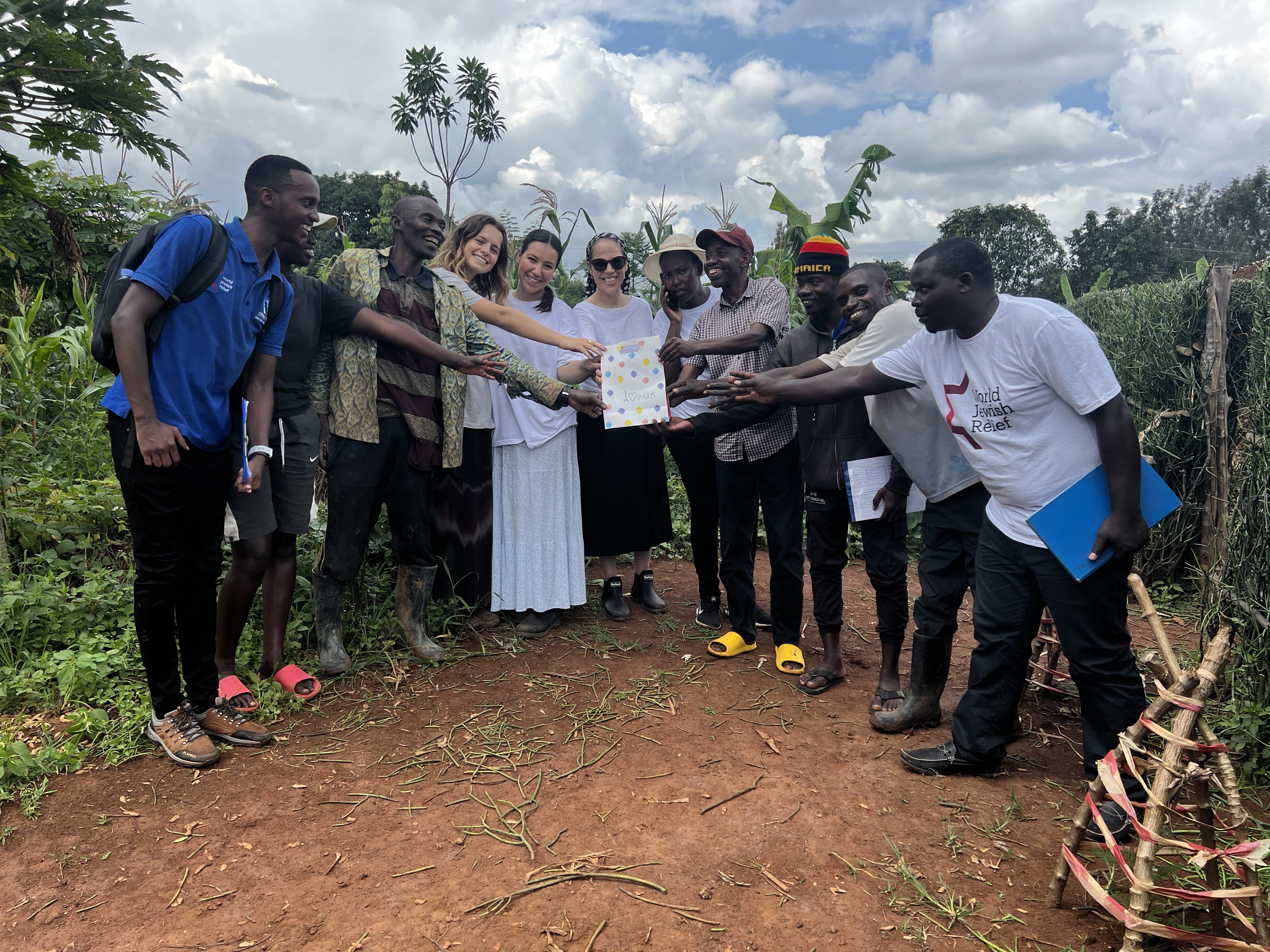
Here is the question: Why, on a good day, would the Chief Rabbi of the UK, Rabbi Sir Ephraim Mirvis, send a group of twelve students to learn about development in Rwanda on his Ben Azzai Programme?
On a good day, we have enough of our own Jewish poor; we have enough poverty in our own backyard; there are people sleeping rough on the streets of London. One does not need to go too far outside their front door to be met with inequality, deprivation, and an urgent need for care. And let’s not forget the age-old adage that charity begins at home. Just to make my point even stronger, if we want to look at our spiritual home, there is an extreme need at the moment in Israel, between a quarter of a million displaced people and an army that is overburdened, and families trying to keep it all together when one of the partners has been away at war for over two months. Do we not have problems of our own? Why in the world and where in the world do we find the justification for looking outside our community at any time, but especially at a time like this? To answer, I will quote Rabbi Lord Jonathan Sacks zt”l:
“To be a Jew is to be asked to give, to contribute, to make a difference, to help in the monumental task that has engaged Jews since the dawn of our history: to make the world a home for the Divine presence, a place of justice, compassion, human dignity, and the sanctity of life. Though our ancestors cherished their relationship with God, they never saw it as a privilege. They knew it was a responsibility. God asked great things of the Jewish people, and in so doing, made them great.”
I’m not as eloquent, so here is my much longer answer, this is something I have been reflecting on and discussing since my first visit to Ghana in 2017. The first is that one has not seen poverty – real poverty – until they come here to Africa. Both in Ghana and in Rwanda, I have witnessed extreme poverty, unlike what one sees in the streets of Western nations. Whereas, at home, there is the possibility (for some, though I know it is not universal) of checking into a homeless shelter, going to a soup kitchen, or a food bank; In Rwanda, where those things may exist, they are limited to just a handful of people. As we heard last week from one of the facilitators at SACCA (The Streets Ahead Children’s Centre Association) – being on the streets in Rwanda is a death sentence, and this happens to children all the time. The children who actually have a parent, even if the family has nothing else, are 100% better off than an orphan. One of our participants was moved by seeing a three-year-old learning how to chop wood at its mothers side; another was in tears meeting a young mother who had brought her baby with her to work on a watermelon farm. Being exposed to such poverty, for me and the participants, sensitized us to our lack of understanding of what poverty really is: in Rwanda, having just enough to live on is very different from our perception of it back at home.

Being a Jew in this world means that we need to hold on to more than just one truth. It is true that our people at home and in Israel need us, but it is also true that others do as well. It is true that resources are finite, but it is also true that we can try to help more than one person at a time. It is true that my heart and my soul live in Israel, but it is also true that my heart is big enough to make room for others who are equally human and equally suffering. It is true that I am a daughter of the Chosen People, and that choice to me means chosen to be responsible for this world that God gifted to us. What that means to each of us may be different at different times. And based on our resources and focus and what speaks to us, it may present itself in different ways.
The students we brought with us are all without question the current leaders in their Universities and will undoubtedly be the future leaders of our community. Our investing in them is in the hope that they will carry with them for the rest of their lives pride in their Jewish identity, all aspects of it, including our sensitivity to people who may seem very far away from us. Their interaction with Rwandan farmers and students will shape the way they interact with other vulnerable people from here onwards.
I would like to share with you a little about the two groups of people we met; the first were farmers. Coming from America, farmers for me were people who work acres of land, with tractors that plough and use other equipment I know nothing about. And though I am aware that farming in America has gotten increasingly difficult and that family farms are struggling, my image of American farmers has always been one of people who work hard and, though they struggle, make ends meet if only just. Then I met farmers here in Rwanda. Farming here is totally different. 72% of the population makes their livelihood as farmers, with the vast majority of those being subsistence farmers, meaning they grow just enough to live on. Owning a cow here is a sign of stature and wealth, but in the main, most people have tiny plots of land that they either own or rent, and they grow on those plots maize, cassava, beans, and bananas, and that is what they eat. These are men and women, many working barefoot, grow just enough to live on, and if there is too much rain or not enough in any given season and the harvest fails, their families go hungry. There is nothing else.

World Jewish Relief (“WJR”) is a small non-governmental organisation (“NGO”) that – in the arena of global NGOs – is tiny compared to UNICEF and Save the Children. What it is doing, despite its size, is amazing. They are using what the farmers already have to help them find better ways of farming. Often enabling change within one season, they help the farmers achieve a level of income they have never previously experienced.
WJR partners with organizations on the ground, encouraging farmers to form small collectives of 6 to 10 members. The members pool together their resources to rent a larger plot of land they could not have hoped to secure on their own, and then they are encouraged to grow a cash crop, mainly tomatoes, green peppers, or watermelon. Unlike their traditional way of farming, they give over the entire field to this one crop, and then the group works together to farm the land. WJR provides what are termed “inputs”; in the first season they give 100% inputs, which includes the seeds, insecticide, antifungals, tarps, and jugs for collecting water, plus hands-on education in farming practices, accounting, bookkeeping, and mentoring, as well as mental health counseling. In the second season, the inputs goe down to 50%, but all the education and counseling and mentoring stay in place, and in the third season, the input support stops, but none of the soft skills and mentoring stop. We met farming collectives in their first, through to their sixth season; some had been super successful. Beyond what they could have imagined earning in their lifetimes, they are now earning in a single season. Others had been less successful, but still were earning surplus income for the first time in their lives. Most have used their income to either expand their own family farms or have reinvested into the collective farm. One man told us that he has bought a bike to make it easier to go down to the local lake to collect water to irrigate the crop.
The second area in which WJR is involved in Rwanda is educating vulnerable young people, especially women. In the SACCA vocational school, we not only saw their work firsthand but participated in it. The school teaches young people four vocational skills: hairdressing and beauty, tailoring, hospitality, and carpentry. We joined in on classes, being taught how to braid hair, make a Rwandan salad, sew a shirt, make a cappuccino, and serve a cocktail. We saw the super simple dorms and were taken to the menstrual room, a room with sanitary pads, and period underpants, and some reading material that explained to the girls what is happening to their bodies and that with the use of the sanitary products they could attend class and, in the future, with such interventions, they will be able to go to work. For me, this was the hardest room because its existence means that this understanding and knowledge aren’t universal, so despite the statistic that 59% of the Rwandan parliament is female, it means that women, in general, are still being held back by a lack of education and understanding. In the SACCA school, the young people learn their trade for 4 months and are placed in internships for two months. During this time, they also receive counseling and mentorship, learn their vocation as well as soft skills, start to understand how to save money and think about the future. They are encouraged to aspire for more than what they were born into. At the end of six months, 92% of their graduates are placed in permanent salaried positions and are independent, many earning enough money to send home to their families. Currently, they have enough space for 120 students, with 32 being residential. Their hope is to expand the school to accommodate between 300 – 400 students. But that will take further investment.

Rwanda is green; everywhere you look, the land looks fertile and like anything can grow. That green can fool you into thinking that this is a land filled with blessings of wonderful crops and harvest. And it can be, but the lack of education has meant that in a country of 12 million people, there are fewer than 400,000 salaried jobs, and of those jobs, most people aren’t qualified to fulfill them. They were not advancing. WJR’s main role, as far as I can see it, is about educating and motivating, showing the people they interact with that just a small investment from WJR combined with their own hard work and forward thinking can have life-changing results.
So why am I here on behalf of the Chief Rabbi of the UK with twelve of the most promising Jewish leaders of their generation? I am here because, as Rabbi Sacks so eloquently put it,
“The first humans lost paradise when they sought to hide from responsibility. We will only ever regain it if we accept responsibility and become a nation of leaders, each respecting and making space for those not like us.”
BACK TO FOOD:
Though there is a lot more to say about Rwanda, and I hope to reflect more in future blogs, I do want to get back to the purpose of this blog, which is all about food, entertaining, and organization. One of the reasons I started this blog was that a number of our synagogue members asked how I do it — how I entertain every week. Usually, it’s one Shabbat meal per week, be it Friday night dinner or Shabbat lunch, and on average, I have about 14 people at my table. The reason for 14 is that this number fits around my table comfortably and it is a large enough group of people that we can host members of our community often and still pay attention to everyone at the table.
Why I need to organise myself:
Hosting this often and still holding down a full-time job as well as hopefully looking after my family and making some time for friends takes loads of organization. Over the years, I have developed many varied methods to just get it done. When I’m consistent and follow the systems I put in place, getting ready for Shabbat and hosting is a pleasure and something I look forward to. On the other hand, when I don’t follow my own good advice, I am rushing, and the adage of ‘running around like a headless chicken’ comes to mind. Even when I am fully utilizing my own organization strategies, my kitchen is a complete mess, but without a system, the kitchen is a bomb site. Instead of coming into Shabbat grateful for the gift that Shabbat is, I am instead exhausted and anxious about the meal ahead. Have I prepared enough, did I make all the dishes I was hoping to make, and will I be at my best at the meal and be the hostess I want to be, attentive and gracious?
Last week I outlined my Friday night menu template . Hopefully I’m sharing this in a sensible way, I’m going to share my method in the order I construct it myself. The first thing I do is build the menu using the template I shared last week (last week’s post). But how do I choose which items fill in those slots? I’m not sure I have a system. It’s often about what is in season, what dishes I know a guest, or a family member prefers, or I want to follow a theme of some sort, and often it’s new recipes I’m trying out.

What to Cook?
One of the rules of thumb I try to follow is that I try to imagine all the food on the table or portions of it on people’s plates. Is there color? Are there multiple textures? Are there options that are comforting, others that are traditional, something fresh, perhaps something unusual yet delicious? This may seem like a ridiculous amount of thought for menu planning, but to me, this is the fun part, and when I’m not feeling creative, I copy the previous week’s menu and just run with it. There have been periods when I have literally made the same dishes for six months in a row. My family has never complained, and nor have my guests, and then all of a sudden one week, the weather will change, and I will find the inspiration to change things up.
Sometimes cooking the same thing week in week out is ok!
A couple of benefits of cooking the same thing week in, week out: you get much quicker at making whatever dish it is as you won’t need to continuously check the recipe, and the method will become second nature. If you are in a period of cooking the same thing over and over, you can always make double of one dish one week and freeze what you aren’t using for the following week. In fact, because I serve both meatballs and schnitzel almost every Shabbat, once a month I make four batches of each and freeze it all for future use.
Cooking in Season:
The benefit of cooking in season is that often seasonal produce is more affordable than produce that is out of season, and in-season produce is usually so much more delicious than out-of-season stuff.
Step 1 – Create a Menu:
Creating a menu is step one; creating the shopping list is step two. A shopping list should be simple and yet I find it the hardest part of my whole method, it’s the bit that keeps me from moving forward because I find it so time-consuming, and yet for my method to work, this is a vital part.

Step 2 – Build an Effective Shopping List:
How to build an effective shopping list – and this is why I find this so time-consuming. It requires reading every recipe and writing down any ingredient that is missing, which requires for me at least multiple trips to the pantry and fridge to check on the state of my ingredients. When I don’t make this effort and just buy ingredients without double-checking, I tend to overbuy the wrong ingredients, overspend, and create unnecessary waste. Basically, I’m not sure I can stress enough how important it is to create a shopping list, and here is where some extra effort goes a long way.
I try to create the menu and shopping list if at all possible, on a Monday latest on a Tuesday – even if I don’t have a confirmed guest list by Tuesday I usually have most people confirmed and that is good enough to get started. Once the menu is set and I check the recipes, double-check which ingredients are missing and the quantities. Included in the shopping list are any extras such as drinks, extra snacks, and other food we may need outside of Shabbat ingredients. And here is where I get serious. I take my written shopping list and transfer it to an app I love called Anylist. On the app – though there is no reason not to do this on another paper list – I separate the items in my list into categories: fresh produce, butcher, kosher shop, pantry staples, and so on. If, like me, you live in a country where keeping kosher means you need to shop in several stores to get your weekly shop, then I will go further and create a list by shop. One of the reasons I love the Anylist app is because I can share my shopping list with my husband, and during the course of the week, if either of us picks up anything on the list, we can cross it off, and the other will see that the item is no longer on the shopping list. Though the ability to share the Anylist comes at a premium, I find it worth it so that we aren’t spending on items we don’t need or running back to the store for items we may have forgotten.
One day soon, I will hopefully come up with a name for whatever this method is that I have created for myself, and that I feel privileged to share with you (and I am 100% open to suggestions). For now, thank you, as ever, for being on this journey with me, and please drop me a line with your own suggestions on how to be the best Shabbat and festival host you can be.
NEW RECIPES:
I just added some new recipes to the site – you will notice that they are all Pesach friendly recipes – but they are equally things I make all year round and are amazing building blocks for a simple yet extraordinarily delicious Friday Night dinner:


