
To Jump straight to menu planning.
Quick note: I am writing this post from Rwanda, and I have so much to share about my time here. Here is last week’s post, I’m finally able to share it now, because I have for the first time this evening enough Wi-Fi to share it. So please excuse the lack of the usual amazing images, or links, as the internet in Rwanda will not stretch that far.
And a second note to say, coming out of Shabbat to devastating news about three of the hostages, which is not reflected in the blog below, but please know I am thinking of their families this evening and of all of us throughout the world.
And now lest get started…
I started this blog just before Rosh Hashanah of this year. The purpose was to have a centralized place to collect all the recipes that I have developed over the years, and a place to share some of the knowledge I have learned after decades of hosting Shabbat and holiday meals. For those of you new to this space, my name is Ilana, and I’m married to a Rabbi. He wasn’t always a rabbi; it was a midstream career change that took our very quiet lives and made them so big. All of a sudden, I went from entertaining when I wanted to (and set my own budget), to entertaining every single week and set to someone else’s budget. I was going to share all the different organizational tools I have developed over the years.
But instead, just a couple of weeks into my new initiative, Israel suffered the massacre of October 7th and the war and hostage situation that has overtaken all of our lives. The number of people I have spoken to – perhaps it’s every person I have spoken to – since Oct 7th, and especially in recent days, has at some point expressed their disbelief at still getting on with their lives. Still going to work, still driving the kids to school, still celebrating Chanukah, still living, when our hearts feel as if they are in a state of suspended animation, just waiting for the next heartbeat. Some of us are actually living from one heartbeat to the next, not certain anymore that the rhythm is consistent. Perhaps if we collectively hold our breath, we can prevent the next bad thing from happening.
But as far as I know, holding one’s breath hasn’t yet helped. So instead, I will try to get back to the main purpose of this blog, sharing my love of Jewish Culinary History, Jewish Food, Celebrations, and how to host them.
A bit of Jewish culinary history: Anyone looking at Jewish communities around the world and especially at Israel at the moment will think we are food obsessed. They wouldn’t be wrong. There is a crazy amount of food being prepared and served to soldiers, from sponsored barbecues and shawarmas to homemade challah and Shabbat meals. The entire country—the ones who aren’t actively fighting a war—is busy making food for both the soldiers and the quarter of a million displaced people from the south and north of Israel.
We come to this food obsession honestly; for most of our history, at least the last two thousand years of the diaspora, most Jews lived in abject poverty. Every penny they earned went towards feeding their families. So much of their lives were focused on putting food on the table. We think of chicken and meat as a big part of the diets of both Ashkenazim and Sephardim, when the truth is that such treats were reserved for special days when the family had saved up to afford such a treat.
A family would have to scrimp and save for white flour for special bread for Shabbat. And gefilta fish became the fish of choice for Shabbat, as the ground-up fish could be combined with breadcrumbs to make it go just a bit further. A cholent was made delicious with extra bones and fat that the butcher would sell at half price, and one herring would be divided among a whole family.
And these were the good times. At our lowest, at times of war, expulsion, pogroms, and flight, the situation became unbearable. I once invited an older couple to us for a Shabbat meal, as the husband looked at my table overburdened with far too many dishes, he looked at me and said, ‘don’t tell me: your grandparents were Holocaust survivors?’ We all carry our trauma and that of the previous generations with us in one way or another. For me, it’s at my table. I don’t know how this current trauma will manifest itself not just in us but in future generations, but it will; it always does, and hopefully, it will do so in some positive way, as it has with many of us. We have created a cuisine that celebrates life in every way, shape, and form. Every lifecycle event is punctuated with food; come to our homes and sit at our tables, and we will share our love for you and humanity, and we will do so through food. This is what trauma looks like to us; we will always fight the darkness with light, love, and food.
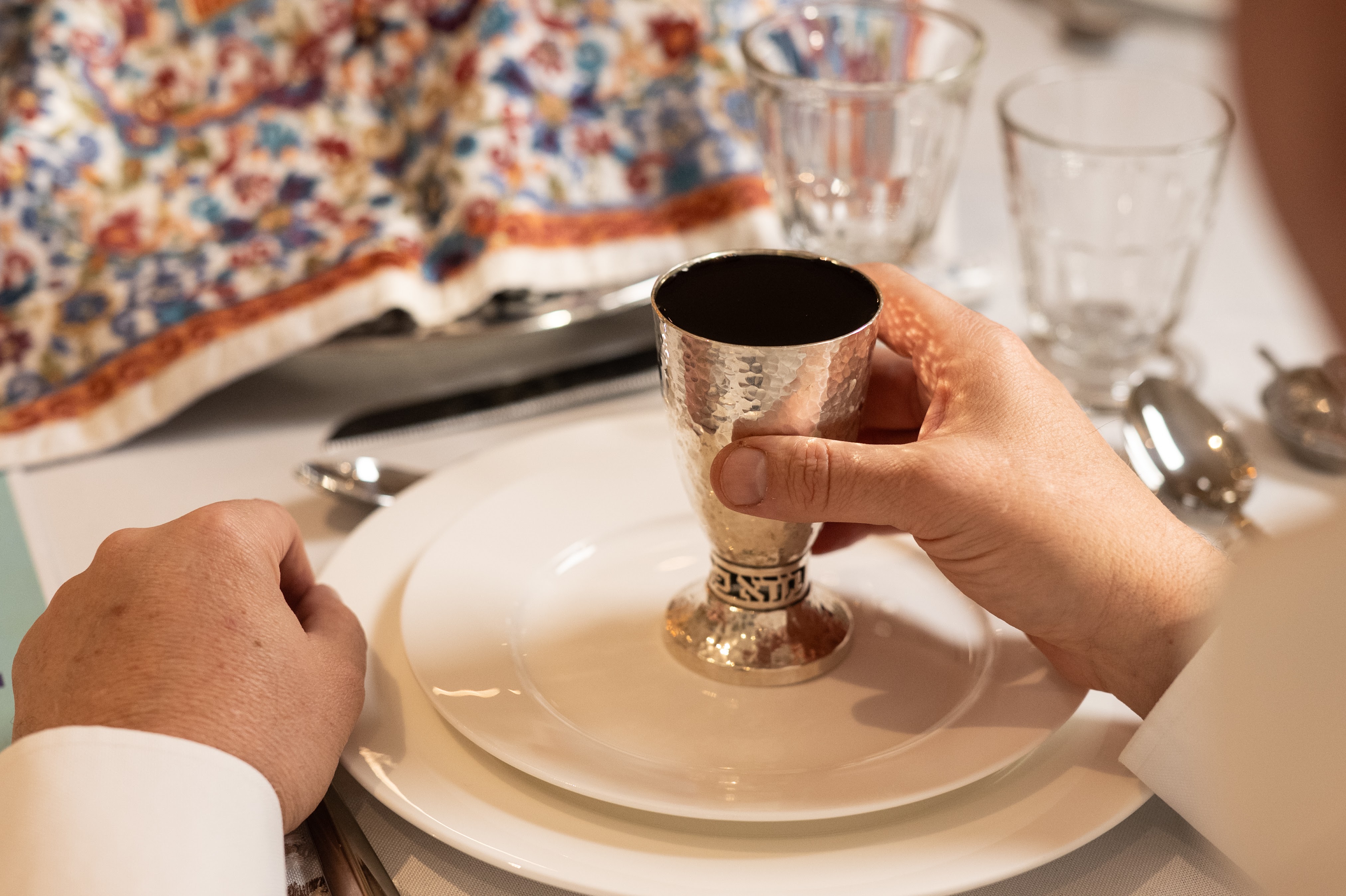
I named the blog ‘Wine & Challah’—the reason being that every time I plan on hosting a meal, I start with a menu. This, for me, is a weekly exercise because I host every week. On a Sunday or Monday morning, I dedicate about 30 minutes to putting together a menu—the menu always starts with the words ‘wine’ and ‘challah’. As all our meals have a ceremonial aspect to them, we only host on Shabbat and Jewish holidays, and only once a year do the words on my menu change from wine and challah to wine and matza.
Once wine and challah are on the menu, I build up the rest of the menu. It’s always divided into three, or a maximum of four sections:
- Ceremonial
- Appetizer (sometimes)
- Mains
- Dessert
With time, I will expand more on each of these sections, but for now, let’s keep it simple:
Ceremonial: This is what we do to make the meal pertinent to Shabbat or the holiday: in essence, the wine and challah. In my case, it would look something like this:
- Ceremonial:
- Wine
- Grape Juice
- Challah
Next is Appetizer: I only serve appetizers at evening meals nowadays; the reason being that we live above our synagogue, and a Shabbat morning (Saturday morning) service in our synagogue always ends with a kiddush (a simple or extravagant buffet preceded with the blessing for the Sabbath day). The kiddush is, in my mind, my guests’ appetizer, thus I stopped serving appetizers altogether, and so far, no one has complained or even noticed that it is absent.
On the other hand, Friday nights and holiday eves, I always serve soup; it’s almost invariably chicken soup – unless I have a vegan or vegetarian dining with us, in which case, I will make a small soup for them.
- Appetizer:
- Chicken Soup
- Matza Balls
- Noodles
- Croutons
Mains: This is where things get complicated and interesting. I won’t lie; I always make too much, but I do start with the best of intentions, which is to serve: two mains, two carbs, three vegetables (of which one or two are a salad depending on whether it’s night or day, hot or cold out). I always prepare simpler food for my fussy eaters (plain white rice, meatballs, or schnitzel, plain broccoli). This may be the thing that seems over the top; I have never once regretted it though, from children to adults, there is always a fussy eater in the mix, whose relief when they see the plain white rice and meatballs is written all over their face.
- Main:
- Chicken (try Tbeet for an all-in-one chicken and rice dish)
- Beef (for a big crowd try my Aunt Eudice’s Brisket)
- Potatoes
- Rice or Pasta (Noodles and Cabbage is my soul food)
- Green cooked Vegetable (Green Beans with Cherry Tomatoes)
- Another cooked Vegetable or Salad
- Salad (Rainbow Salad)
Dessert: I am a dessert person, and I love beyond anything for people to have lots of small things to choose from at the dessert part of the meal. When I first started entertaining, I would make lavish desserts that would be literal show-stoppers, and though delicious, our guests would love them, and at the same time, lots of people would pass, preferring to have fruit or some nuts. With time, I have come to realize that putting out a sampling and mini dessert options seems to work better for my guests.
I will make a selection of simple loaf cakes, a brownie and cookies – both homemade and store-bought – mini dessert cups and so on. Everything is made ahead of time. So many of my cakes can be made and frozen that I usually have a selection in the freezer. I will assemble a few trays, each with a selection of baked goods already cut into bite-sized portions along with small dessert cups. In between the baked goods trays, I place plates of cut-up fruit, bowls of nuts, candy, and chocolates. Dessert is always my favorite part of the meal. Not only because I’m sweets obsessed, but because people have relaxed by then and are helping themselves to small nibbles while chatting.
- Dessert:
- Cake
- Cookie
- Dessert Cup (optional)
- Fruit
- Nuts
- Chocolate
With this as a building tool, I fill in the specifics of each dish, and my menu is on its way. I know this isn’t rocket science, and many of you will already have your own way of building a menu, yet having this framework helps me as I don’t feel like I’m starting from a blank page; rather, it’s the perfect jumping-off point.
Next week I will share how I make this list into a reality without actually losing my mind, and in a way that enables me to still hold down a job, and that cooking for Shabbat and holidays doesn’t take over my life. And yes, it’s all about planning and organizing.
One last thought: I have spent years building up different personal organizational tools for every aspect of my life, from cooking to brushing my teeth, and when it’s too hard to do anything else, remembering those tools has been a godsend. So even if hosting, cooking, entertaining is the very last thing you want to do at the moment, once people are sitting around your table, you may feel differently. But in order to get to that point, you will need to do just a bit of planning!
Thinking of all of you and wishing us all a quiet and peaceful week ahead.
One response to “Why Wine & Challah?”
[…] I construct it myself. The first thing I do is build the menu using the template I shared last week (last week’s post). But how do I choose which items fill in those slots? I’m not sure I have a system. It’s […]