
Jump straight to a Lubavitcher Custom or to the new Recipes.
When I feel exhausted — and there is no way to avoid that exhaustion in the middle of the High Holy Day period — from the endless cooking and preparing to the lovely yet long hours spent in synagogue, for me the Yom Tov exhaustion is unavoidable. In order to keep going, and to keep cooking when all I want is a box of chocolate and to binge Netflix, I feed my curiosity instead.
I find that if I understand a food or an ingredient, I’m far more motivated to cook with it. So if your exhaustion is getting the better of you, and curiosity can be your motivator, I offer you below the history of kreplach.
Wishing you happy cooking and a continued blessed Holy Days season ahead.
WHAT ARE KREPLACH?

People throughout history were innovative in the kitchen, finding a multitude of ways of making the basics into something special, and finding different options for combining what they had into something new and hopefully edible. The idea of cooking strips of dough made of flour and water is ancient, found both in the Far East and in the Mediterranean. By the Middle Ages, pasta had become firmly rooted in Italian cuisine, long before Marco Polo ever made his famous journey. Jews living in Italy would have been influenced by their neighbours and cooked in a similar fashion to them, with the overlay of kashrut observance and religious custom.
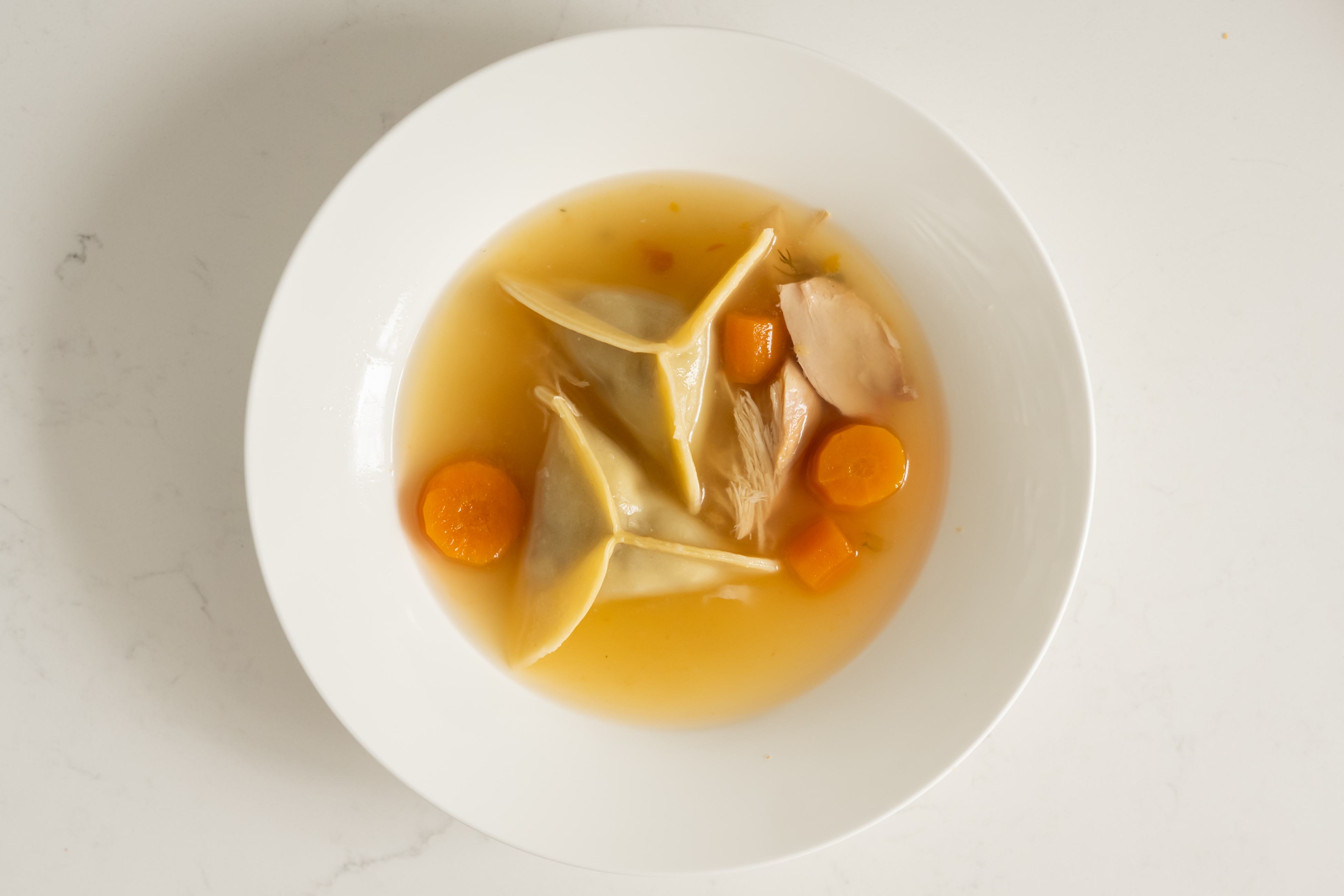
Krepl (the singular of kreplach) is a filling encased by pasta. Kreplach were probably first made in the Middle Ages in Northern Italy. Soon after, kreplach made their way north to Germany. Many of the Ashkenazi food traditions we know of were influenced by Northern Italian Middle Ages cuisine and then travelled with the Jews from Germany to Eastern Europe. In Eastern Europe, among the non-Jews, there is a strong tradition of filled pastas. It is possible that they were influenced by their Jewish neighbours, or was it the other way around?
These delicacies, both in Jewish and non-Jewish homes, because they are time-consuming to make, were often associated with festivals and had the added benefit of extending the filling — often the most expensive part of the dish — further. Boiling the dumplings was a new cooking method in the Middle Ages. It was a money saver, as boiling the dumplings in water was cheaper than frying them in fat. Later, boiling them in chicken broth, as Jews do, saved even more.

The reference to symbolic foods on Rosh Hashanah that we find in the Talmud may have us believing that every holiday has symbolic food, and they do. But know this: the holiday comes first; in many cases the symbolic food was a later add-on. The holidays are expressly written about in the Torah and later explained and transmitted by the writings of the Rabbis.
Yet every community and family has food traditions revolving around each and every holiday.
The explanation, to my mind, is simple.
These food traditions, to me, are what happens when prayer is over. When we sit at our tables, our family and friends, and those strangers that are just minutes away from becoming friends, awaiting Kiddush and the challah under the cloth. Another harsh truth: the bread under the cover can be a baguette or an unsliced burger bun. It needn’t be a challah. The meal needn’t be chicken soup with lokshen or kneidelach or kreplach — it can be a burger and fries.
Yet that is not the way we see our Shabbat and holiday meals playing out. The reason is one of education. We wanted (by “we” I mean Jewish homemakers of the generations past, of today and of the future) to create a holiday atmosphere not just in our synagogues but also in our homes. We wanted this meal after prayers to be special so that our children would anticipate them, look forward to the once-a-year treat of a special food associated with a particular holiday.
Rather than being arbitrary about it, we found foods that thematically aligned with the spirit of that holiday, and thus kreplach in the Ashkenazi world became associated with different holidays — in particular, the meals before Yom Kippur, Hoshana Rabbah and Purim respectively. Yom Kippur in particular, as we prepare for a full day of prayer, as we eat our last meal before the fast, kreplach became something that Ashkenazi Jews came to look forward to, and have, over the generations, read meaning into.

Otto Wallish, Eri Wallish Collection, the National Library of Israel
Can you have the meal before Yom Kippur devoid of chicken soup and kreplach? Absolutely — but the question is, should you? Judaism isn’t meant to be a religion on the periphery of your life, a synagogue you show up to, a kippah that is dug out of your back pocket when needed. Judaism is an immersive and experiential way of living. We are Jews at all times. From the moment we wake up to the moment we go to sleep. Judaism tells us how to behave. Even in my dreams, I seem to live a Jewish life. Many of us are so careful to ensure that we only eat and drink foods that do not transgress kashrut laws, but are we as careful to bring the joy, to add the symbolism, to feel our Jewishness not just with the things we don’t do, or don’t eat, but also with the things we do eat, the commandments we keep, the homes we create?
Eat kreplach if you can. In the kosher shops across London you can buy them ready-made. I hope they are available wherever you are reading this. But if you have some time on your hands (it will take you around two hours from start to finish to make the kreplach recipe below), make your own — not because there is some added significance or virtue in making your own, but rather because homemade kreplach are delicious.
A LUBAVITCHER CUSTOM:
One more thought: as we dive head-first into this year, I wanted to share with you a tradition from many Lubavitcher households. On Erev Yom Kippur, in each family, someone is selected to give out honey cake, but the difference here is that in order to receive a slice, one must ask for it. So, rather than take the honey cake, or distribute the honey cake, one must ask for a piece and everyone in the family does this.
The explanation for this is wonderful. We need to know that all our wealth is a blessing from God and that, without His blessing, we can find ourselves in the worst of circumstances in every aspect of our lives. We too could be the person out on the street sleeping rough, begging for a morsel of food or a warm place to sleep. Asking for a piece of cake reminds us of this. At the same time, we hope that asking for this one sweet thing from a person we love feels like a gift and not like asking for a hand out. And we should learn what it feels like to ask, so we can be sensitive to how hard it is for others to humble themselves enough to ask for the things they need.

Wishing you a year ahead wrapped in the embrace of God, protected by His divine mantle and shielded from the harsh world around us.
NEW RECIPES!!!!!
I offer you Onion dip, inspired by our daughter Odelle’s love of the dips and spreads, served as part of what we have started calling the ‘challah course’.


Here I give you two recipes to keep in your back pocket. Trust me on this — the first one, Large Batch Fried Onions, is a game changer. With a technique adapted from America’s Test Kitchen, a very small amount of oil is all you need to fry a whole batch of onions, as long as you add some water and have the right pot to do it in.
Once you have your fried onions (this recipe makes three cups’ worth), you can use them in a variety of dishes — from onion soup to a topping for mujadera. The onions can be made ahead of time and frozen, then defrosted when needed.
Once I had the fried onions ready to go, Odelle told us about the onion spread on challah. Just a couple of ingredients and the fried onions turn into a dip that will have you reaching for challah, or any flat edible surface, to scoop up this addictive spread.