
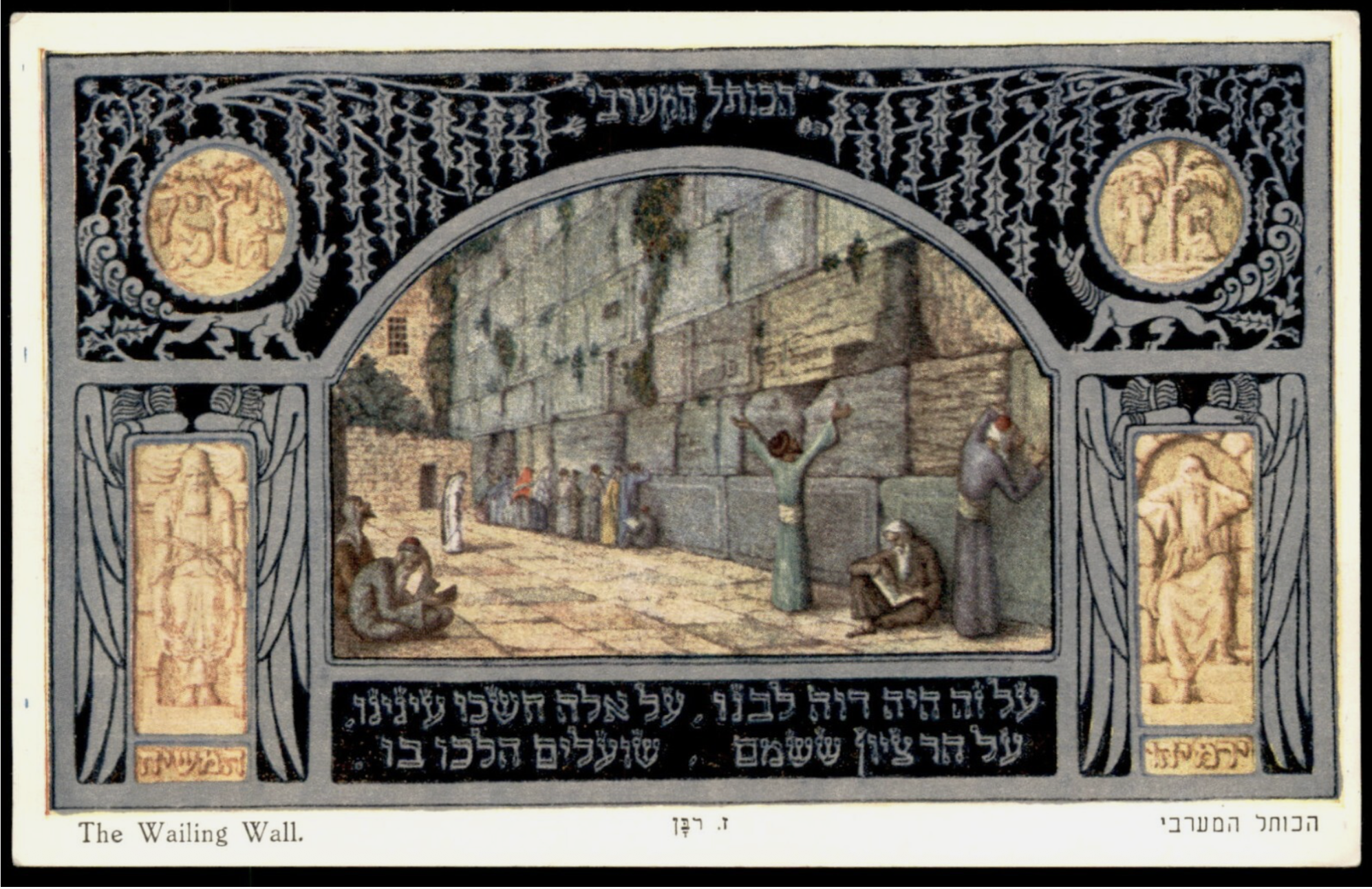
Image of the Wailing wall by Ze’ev Rabban c.1931
Jump straight to the Food section, or to the new recipes on WineandChallah.com or this week’s Summer Shabbat Menu.
In the summer of 1995, Daniel was working on the Aish Fellowships in Jerusalem (a programme to teach Jewish young people about their heritage and traditions). That summer, I spent time with friends and family in Israel prior to starting my last year of university.
On the Eve of Tisha B’Av, the saddest day in the Jewish calendar – when we commemorate the destruction of the Temples in Jerusalem amongst so many other national tragedies – my cousin Dina and I made our way to the Kotel. Jerusalem was heaving with young people and, as we made our way from the Hurva Synagogue (at the time still in ruins) to the Wailing Wall, it was a sea of people walking in opposite directions; some going down to the Kotel to weep at the last remaining outer wall of the Temple that once was the centre of the Jewish beating heart, and others walking back from their pilgrimage. As we made our way down the familiar steps, it was almost silent, as greeting each other on Tisha B’Av isn’t really the done thing. But it’s never truly silent, and a hum of voices surrounded us. Beggars asked for money and others sold red string that they claimed came from the covering of Rachel’s tomb in Beit Lechem.


Purple Arches I and II by my incredibly talented mother Nira Spitz
Amidst this sea of humanity, I glimpsed Daniel walking up the steps as we made our way down. I had just been telling Dina about the boy I had a crush on and had been on a couple of dates with, but I wasn’t sure if he was serious, and then he appeared. I pointed him out, not to say hi, but rather to give Dina a visual. Dina, being so totally herself, didn’t let the opportunity pass and shouted ‘Daniel!’ getting his attention.
Daniel, already looking up and seeing me, said — because he is religious that way — that he would call me the next day after chatzot. In traditional Jewish practice, the stringencies of conversation on Tisha B’Av are less restricting after midday. Daniel did call and we arranged to meet after the fast.
Not until today did I realise we were following in the tradition established in Ancient Israel. The tradition of reconciliation after devastation; that selfsame tradition that has kept Judaism going for the last three and a half millennia. After the house has burnt down, and you have mourned its loss, you pick yourself up, wipe off the grime and rebuild.

In Mishnah Ta’anit, which dates back to the Second Temple, we have a list of the special days in the Jewish calendar and we read of Tu B’Av, the 15th day of Av, just six days after the fast of Av, the day that represents the worst of our tragedies starting in the desert. This is a day of communal healing. No days, says Rabban Shimon ben Gamliel, were more joyous in the Jewish calendar than the 15th of Av and Yom Kippur (we will need to leave Yom Kippur for a later discussion). He tells us that on that day the daughters of Jerusalem would dress in white, one girl borrowing clothing from another, so that no one was embarrassed by what they had or didn’t have. The girls were to go out and dance amongst the vines and the boys were to see their inner beauty and choose a wife. If dating apps can work, why not dancing in a vineyard?
But this was far more than just an ancient mating ritual. It was a representation of national healing.
It is said that on the 15th of Av, in contrast to the 9th of Av where tragedy is piled upon us, reconciliation happened historically on this day. In the Book of Judges, the prohibition for tribes of Israel to marry between each other was lifted. The tribe of Benjamin, after a civil war, reintegrated with the other tribes (Shoftim 21). Of the generation of the Children of Israel who were to die in the desert, the deaths ceased on that day (Bamidbar 14). And after the fall of Beitar during the Bar Kochba rebellion of 135 CE, the dead were allowed to be buried (Ta’anit 30b).
I know that none of these sound like romantic events (even the dancing in the vineyard seems somewhat less than romantic and more like a marriage mart) but that was the point. In today’s day and age there is a move to restyle Tu B’Av as the Jewish Valentine’s Day, with florists all across Israel commercialising the day. But in truth that isn’t the kind of love being celebrated traditionally on Tu B’Av. It was a moment of communal healing that came on the heels of communal tragedy. It’s about the love between God and His people, and love as endurance.

In contrast, Valentine’s Day finds its source in the Roman pagan fertility festival of Lupercalia, and later in the 3rd century, when one or a number of people identified as Saint Valentine were martyred by the Romans for spreading Christianity and helping Roman soldiers—who were not allowed to marry—to marry in secret. Lupercalia shed its pagan origins and gained a Christian veneer. During the Middle Ages, that day came to represent a sanitised courtly love. Today it remains a celebration of passion, attraction, and a celebration of couplehood. Valentine’s Day isn’t about community; it is about two people who stand apart in their togetherness. While Tu B’Av is about Jewish continuity after tragedy, it’s about healing by building families.
This year, while we face a world where it is no longer considered taboo to be antisemitic in public, where Jews around the world face fear and tragedy on a daily basis, we have never needed the reconciliation of Tu B’Av more.
I wish I could tell you how to celebrate; sure, find a handy vineyard, put on a white borrowed dress and dance, that actually sounds like fun! But if that isn’t an option, celebrate love. Love of our families, love of our communities, how we will survive, because we have survived, because both our pain and our joy isn’t something we experience alone, but something that in Judaism we have always experienced together. As the Sages teach: “Kol Yisrael arevim zeh bazeh” — all of Israel are responsible for one another (Shevuot 39a).
Thirty years later, I can tell you that the after-Tisha B’Av date with Daniel didn’t go as planned, but that is a story for another day.
In the concluding word on Mishnah Ta’anit, Rabban Shimon ben Gamliel says: “And on the day of the gladness of his heart”; this is the building of the Temple, may it be rebuilt speedily in our days. Amen.
FOOD: Because, ultimately this is meant to be a blog about food!
We are officially in August and at the height of summer — which should mean it’s super hot… but this is England, and we swing between heatwaves and cold showers. So while the produce is amazing, the season doesn’t always feel summery.
With that in mind, here are a few new, super summery recipes that — if we are blessed with heat — will definitely be on our table in the coming weeks.
New Recipes on the Website:
Our new food shoot means that I have slowly been adding new recipes to the site. Today I actually will be having my last food shoot with Blake before we start packing up our kitchen for our big move. My hope is to photograph all the most iconic Ashkenazi food I make and spend the next few month uploading slowly on to the web site, so stay tuned! For now here are some Shabbat lunch staples that are in regular rotation in our home: Daniel’s Cold Roast Beef, Gazpacho, Viennetta, and Parev Pesto.


Summer Shabbat Menu:
Summer shabbats have a pace all their own, Friday night dinner is later, the days are hot and long, and sitting down to a heavy piping hot meal, may not be what you are looking forward to. In this week’s suggested Friday night and Shabbat lunch menu, I’m sticking to the traditional and at the same time, acknowledging the heat and the pace of summer days. Including, Challah (of course), Green beans and Cherry Tomatoes – easy and just light cooking needed, Chicken with Noodles – a Sephardi Classic – browning the chicken is an essential step in this dish – but well worth the effort. A plate full of either of these salads Green Tahini and Herb Salad Platter or Tabouleh-like Couscous Salad are a celebration of summer, and don’t miss out on last week’s featured recipe – Blueberry Lime Cake – summer in every bite!
Friday Night:


- Wine and Challah
- Green Tahini and Herb Salad Platter
- Chicken and Noodles: Pollo con Fidellos
- Green Beans with Cherry Tomatoes
- Blueberry Lime Cake
Shabbat Lunch: