
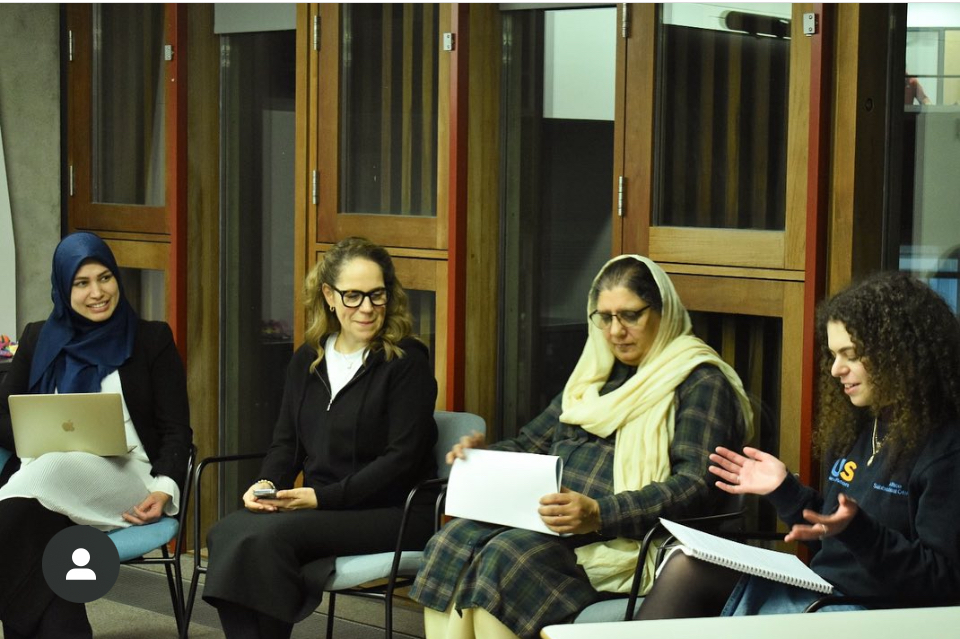
& Interfaith Head Covering
This week I had my first interfaith conversation since the 7th of October. Daniel and I have been involved in numerous interfaith initiatives since taking up our communal roles in 2014. It was, in fact, a big part of our lives. On the 5th of October we hosted an interfaith gathering in our sukkah (the temporary dwelling we set up to celebrate the festival of ‘Sukkot’ – Tabernacles). After the 7th we heard from a tiny handful of our interfaith community. I would like to tell you how I feel about that, but frankly I don’t know, and more time needs to pass before I think I will understand my own feelings. Let’s get back to this past week. The JSoc (Jewish Society) of the London Universities asked me to be on a panel with other women of faith about head coverings. Politics were not on the table.
In an effort to be totally frank, I told the organizer that I hadn’t always covered my head, though I did so directly after our marriage. However, after a few years, I found it incredibly difficult to do. As our eldest became bar-mitzvah, I started revisiting the mitzvah of head covering, learning more and more about the what and the why of it all. The point of entry to the mitzvah of head covering was as a young bride from a purely communal religious environment in which we were living. Later, the push factors were from a variety of areas. It was mainly halachic (the act of following Jewish law and practice) consideration; still communal, but from a responsive rather than reactive point of view. It became about my marriage and not just about myself. Regardless of how I came to cover my head, the organizers were happy to include me on the panel.
I sat between Surinder Sahota, a Sikh woman; and Sara Abidi, a Muslim woman. Initially, neither woman realized that I covered my hair or that I was in fact wearing a wig. (Does it count when others cannot tell if you are covering your head?) The Sikh woman wore a headscarf that she wore attentively on her head and around her neck prior to us sitting down for our discussion at which point the scarf was around her head. She would often subconsciously adjust it, in a movement she must have done millions of times throughout her life. And the muslim woman wore her hijab, with just her face on show.

This isn’t the forum to get into the details of the conversation. If you though would like to watch it you can follow this link.
Rather, it is a conversation about hope. Are things bad for Jews out in the world? Undoubtedly. Are we frustrated with self hating Jews? More than ever. Are things going to get worse? I’m no Jeremiah, but two men I had the privilege of hearing this past week, Roni Flamer of Or and Professor Jonathan Haidt. Over the last twenty years, Roni has brought over 600 families to settle in the South of Israel, and was responsible for the settlement of some of the families in the Gaza Envelope communities, who suffered untold tragedies on October 7th. And Professor Jonatha Haidt, acclaimed Social Psychiatry who has written non-stop about the influence of social media on generations Y and Z. Both said that in their respective worlds, it’s going to get worse before it gets better. Yet both said, and I will repeat it, better times are ahead. We may ‘fall off the cliff’. According to Professor Haidt, the world ‘falls off a cliff approximately every 80 years’. Yet, ultimately, there is always better ahead. History has comfort built into it; in the fact that it is always bound to repeat itself. The pattern always repeats itself.
What does ‘better’ look like? Is it three women discussing passionately how much they connect to covering their heads as women of faith. We discussed how we walk through the world connected to our Maker, never forgetting that relationship, or who we are. It felt like a spark – a small one but a spark nonetheless – and I now need to ask myself: am I brave enough to have a second conversation? This one was confined to head covering, maybe the next one can be confined to food. Who knows? But only if we are willing to put ourselves out there is there hope for peace, or is it too soon. On the other hand, is it ever too soon to hope?
Saba Shalom’s Bakery:

My mother is the descendant of bakers. Her father – my Saba Tzvi, was a baker. My Savta Zahava’s (Zahava was Tzvi’s wife) father Shalom was a baker as well, as were his father and grandfather before him. And probably for generations before that as well. We aren’t actually quite sure where this side of my Savta’s family came from, but we do know that by the late 1800’s they were living in the Bukharian neighborhood of Jerusalem, serving the neighborhood, baking their daily bread.

Later, my great grandfather Shalom left the comforts of the bakery in Jerusalem and headed north to Haifa where he opened the first Jewish bakery in that city since the time of the Mishnah (third century CE). Haifa is a city with a dynamic port that, at the start of the twentieth century, was going through a tremendous boom, with more and more Jews moving into the area to serve the needs of the port. My great grandfather Shalom, upon his marriage to my great grandmother Sa’ada, was given a plot of land in the lower part of the city as a wedding present from Saada’s brother, Yosef Amsalem. They started by building the ground floor, and in that ground floor they built the bakery. My Savta Zahava would recall that, as a young girl, she would sweep the bakery floor and, together with her donkey, made deliveries of bread around the neighborhood.
Challah History Part 2:

One of the most seminal moments of Jewish history was when the second Temple was destroyed in Jerusalem in the year 70 CE. I’m not sure how the sages understood then that this destruction, unlike the destruction of the first Temple in 586 BCE, was to lead to a long diaspora – one that we are still in today – but they did. And customs came to replace the Temple ritual. The large Temple, with its altar, was replaced by our small temples (in Hebrew: “Mikdash Me’at”) – our homes – and our tables replaced the altars.
According to culinary historian Gil Marks, in the early medieval period Jews in Babylon started making the Hamotzi blessing over two loaves of bread on the Sabbath and Holydays. These two loaves represented the double portion of Manna the Children of Israel gathered on a Friday so they would not transgress the Sabbath by gathering manna on that holy day. The custom then further developed to place the loaves on a board or cloth and cover it with a cloth, representing the dew that covered the manna from below and above. Furthermore, many Jews would (and still do) sprinkle their shabbat loaves with seeds. These, too, represent the dew that covered the manna.
Amongst Sephardi communities there were no special shabbat loaves. They would use their weekday loaves to recite the Hamotzi blessing, yet in honor of Shabbat these loaves would have been made with fine white flour and sprinkled with sesame seeds.
Amongst Ashkenazi communities, where white flour was harder to come by in Northern Europe and prohibitively expensive, Jews would save up all week to have enough money to make even two small loaves of white challah. At times, the community welfare organizations would step in to aid families that could not obtain white flour.
The Ashkenazi braided loaf we are so familiar with today – the loaf we call challah – is something we learned from our Christian neighbors. Initially, Ashkenazim – like Sephardim – had no special shabbat loaf aside from trying to ensure that they could make a loaf from white flour. Yet, over time, the Ashkenazi Shabbat loaf turned into a golden braided one. How and when did this change happen?

Amongst the Germanic tribes, in honor of the winter solstice, they would prepare special loaves, with some shaped like animals. When Christianity emerged, and incorporated many local costumes into church practice, specifically shaped breads to celebrate and commemorate became the norm. There was, in Teutonic tradition, an ugly evil crone with long matted hair – called Frau Holle. Germans would twist dough in shaping bread loaves that were then offered to Frau Holle in order to escape her punishment. Though the Jews living in Germany did not worship Holle or most probably know much about her, they certainly did see and admire the attractive bread, and started assimilating it into their practice. “Medieval German Jews also adopted a baby-naming ceremony called Hollerkreisch, “Holle’s cry,” in which the cradle and baby were lifted up before confirming the infant’s German name.” (Marks, Encyclopedia of Jewish Food, page 98).
Soon the braided loaf came to be served at special occasions throughout Germany and became the most popular form of Ashkenazi shabbat loaf.
With time, the shabbat loaf got richer and richer. Plain bread continues with just a handful of ingredients: flour, water, yeast and salt. The shabbat loaves of Ashkenazi Jews now additionally contained oil and eggs. These additions didn’t just make the loaves softer and richer, they helped them stay fresher for a bit longer as well. It is only at the start of the 19th century that the Ashkenazi Jews started adding sugar to their challah, further enriching it.
Refua Shelima for Ari Spitz:
Next time, we will get back to the history of challah and of my family bakery in Haifa. For now though, I would like to end by sharing a message of hope. The anthem of the State of Israel is called HaTikva – the hope. Israel, for all of its existence, both before and after the establishment of the State, has never been easy. It has never been easy to be a Jew, I agree that in the last five months it feels like it just got all that much harder. However, in all that challenge and in all that difficulty, in the 3000-plus years of history, we have learned one prevailing lesson: the only way to make it through the hard times – and there have been so many – is to learn to hope. Tikvah. I ask that if you have a moment please say a prayer for the Refuah Shelima (full healing) of my cousin Ari Spitz, Moshe Aron ben Leah Bayla.

New Recipes:
I don’t know about you, but the winter blues are starting to get to me, to combat them I’m sharing with you some of may favourite recipes. Moroccan Style Apricot Chicken is so delicious, yet I will not lie, there is time consuming work involved, but its guaranteed to brighten up your day and would make the perfect main dish for a Purim feast. Serve it along side Couscous which is the perfect accompaniment to soak up all the amazing juices from the chicken. And lastly have a go at making Ka’ak, these visits are unusual in that they are savoury, but insanely delicious Savoury Syrian Ka’ak Cookies and are the perfect snack any time of day.


One response to “Challah History Part 2”
[…] is used to describe the Shabbat loaf is in 1488. It is possible that the braided Holle bread (read this article for more) sounded a lot like the biblical term challah. It’s not until the 17th century, […]