
Jump strait to More Places to Eat in Jerusalem or to New Recipe
In 1982 my eldest brother celebrated his bar mitzvah. We were living in Rio de Janeiro at the time and travelled first to New York and from there on to Israel. For my siblings and me, it was our first time in Israel. For my parents, who had both left Israel as children, it was a return home.

We landed in Ben Gurion Airport. The airport we landed in, aside from the location, has nothing in common with today’s modern and beautiful airport. Once past passport control we walked out of the building onto the street, where the luggage conveyor belt was on the outside of the building. White seven-door Mercedes-Benz sedans with Arab drivers waited on the street with palm trees behind them swaying in the dusty air that felt dry but not hot, as it was January. On the other side was the airport building and the luggage belt that snaked out of the building directly onto the street. Anyone could take your luggage if they pleased, but no one did. As a world-weary traveller (at the Age of Seven), I understood that this was not the way things were done, and yet in my parents’ homeland things were different.
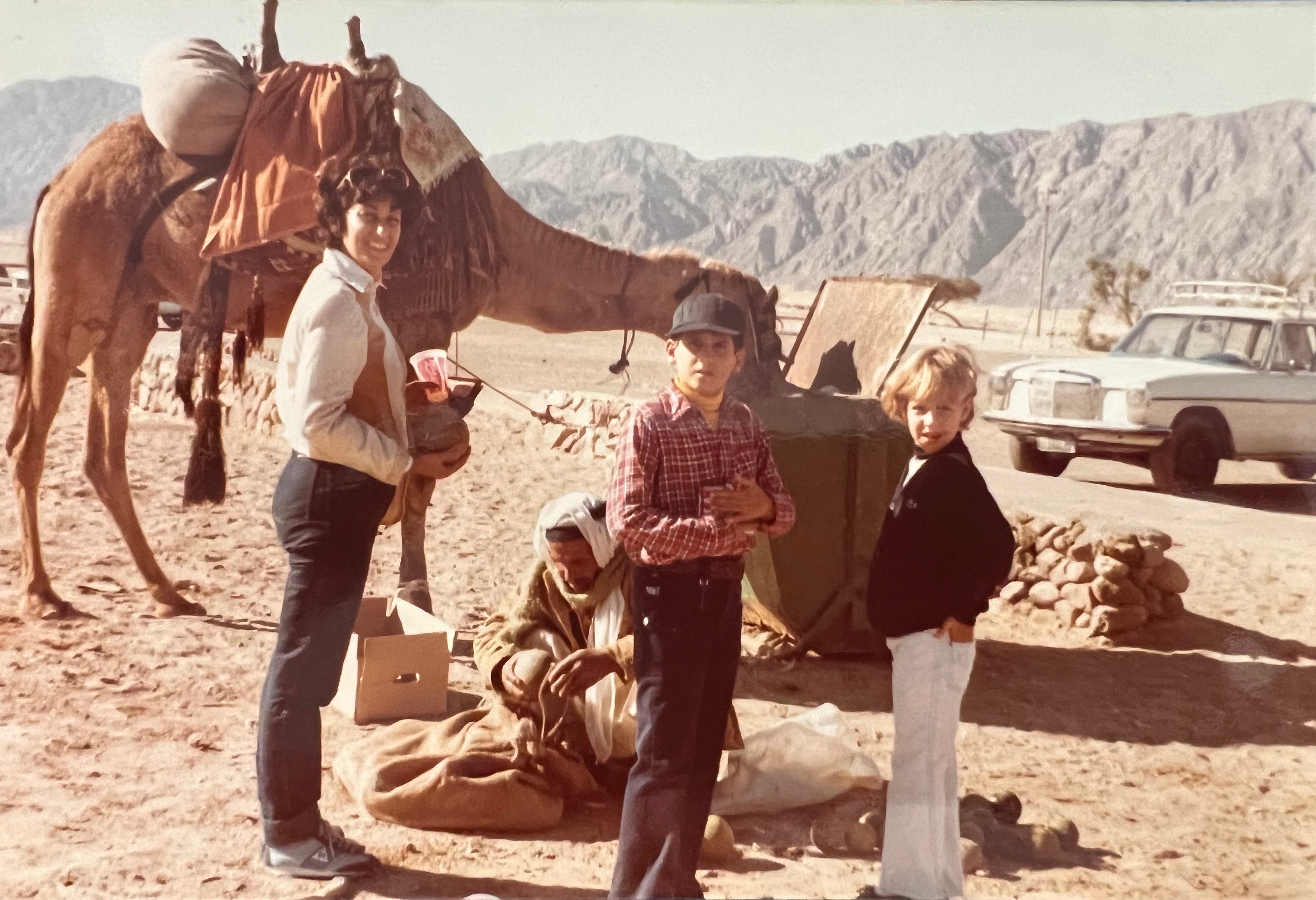
Recently I looked back on the album of that trip. Yes, it was primarily a bar mitzvah trip, but there was a secondary objective. My mother especially wanted to share the love of her homeland with her children. She took us from one end of the country to the other. As soon as I saw the photos, the memories came flooding back. The country felt both old and brand new at the same time.

We stayed in Jerusalem at the Jerusalem Plaza Hotel, just off of King George , with a Pac-Man game in the lobby and high glass walls we threw sticky toys at while we watched them slowly descend. In Tel Aviv, in Haifa, and in Arad we stayed with family. In Eilat of 1982 there was just a youth hostel and camels, and Aqaba across the sea was the more developed of the two towns. In Metula in the north we saw the cedars the Psalmist wrote about. In Acre (Akko) I sat mesmerised watching the water flood the causeway. In Meron we visited my mother’s family legacy – the grave of Rabbi Shimon bar Yochai. In Haifa we visited the Bahá’í Gardens, marvelled at the beauty while having cup after cup of tea with my mother’s extended family. At my Great Aunt Sima’s house we had a family reunion.

I’m not sure how long our stay was, but the album says Jan–Feb ’82 and my brother’s bar mitzvah wasn’t until the middle of January. We must have spent at least three weeks to a month going up and down the country. My mother’s determination to share her love with us worked, as my eldest brother has made his home in Israel for nearly thirty years, and the rest of us are determined to one day be able to live there permanently.


Yet does the Israel of then have any bearing on the Israel of today? Is it the same place, are these the same people? Obviously not. The Israel I saw was through the eyes of a child – both mine and my mother’s. She had left Israel as a ten-year-old and wanted to rediscover and introduce it to us, the best bits. Though we did experience pain as well. We visited the graves of my grandfather Tzvi in Haifa, my mother’s beloved father, who had passed away a year and a half before our trip, and my grandmother Eta’s grave in Arad, the woman I was named after who had passed away ten days before I was born, whose existence I didn’t know of until that moment even though I was named after her.

Israel today is a land of constant building. Every city gets taller; mammoth buildings are being built everywhere to accommodate everyone. Eilat is no longer a town where the main attraction is riding camels. My grandparents’ apartment at the very edge of Arad when I was a child is now in the centre of a sprawling town. The highway to Jerusalem, once a two-lane affair (one into town and one back out) with burnt-out trucks from 1948 decorating the side of the road, is now a multi-lane highway cutting through the mountainside in order to accommodate the traffic. My mother remembers travelling by train all day from Haifa to visit her grandparents in Jerusalem; today the journey takes no more than two hours.
Yet there is still a dream. And that dream has not changed. On Shabbat I thought how unique our prayers are—not just the liturgy but how we do it. The need for a minyan, for a group of people to come together and say the words of the prayers together, to find comfort together and to ask for our national needs together out loud. We have been praying for our homeland since before we had one. We spent forty years in the desert dreaming of home. We saw Moses lose his opportunity and understood that we, who are not Moses, could and would lose it as easily. That the homeland would never be an easy undertaking but be the glue that has kept us together, the focus of our prayers. The cynic in me thinks it can never be perfect, because then why would we pray? It is, in fact, the thing that God warns us of time and again. It is when things get perfect that we will become decadent and forget about Him and turn from our Torah values.
The Israel of today can be seen as decadent in some ways—the amount of croissants I have consumed in just the last two weeks is, in fact, decadent. Being able to eat almost anywhere as a kashrut-observing Jew is decadent. But the struggle is all too real. One does not forget in Israel how precarious our situation is, how quickly the winds of war blow in and out. It feels, at this point, like Israel is holding its collective breath, waiting for what will come next.
But while we hold our breath—something we have been doing for a very long time—Israel does not stand still. It builds and it grows, and it innovates in the quietish time so it can be prepared for the ‘next’ that will inevitably come our way.
Jerusalem of 1982 was not a place that had cafés and restaurants literally on top of each other, fighting for airspace and sidewalk tables as they do today. My brother’s bar mitzvah meal was held at the Quarter Café, a simple café in the Old City. We ate off cafeteria trays, and for once I can’t remember what we ate, but I remember the joy of it all—being surrounded by family and friends. And though Jerusalem and Israel have changed, as they should, that feeling of being surrounded by my people has not.
Wishing you, wherever you find yourselves, to feel surrounded by love and friendship.
More Places to Eat in Jerusalem:
The longer our sojourn in Jerusalem is, the more amazing places I eat at, but the more I’m itching to have my own kitchen and experiment in recreating the wonderful food I am tasting. Here are a few more wonderful places to try out the next time you find yourself peckish and in Jerusalem!
Janjariya and Café Ramban – In this new hotel in the heart of Rechavia, they have opened two restaurants. I am yet to try out the dairy café – but I have it on good authority: ‘great breakfast – actually the best!’ – Thank you, Daddy! Daniel and I had dinner in the meat restaurant; the music is loud, the atmosphere is young, and the food is exceptional. Order the prime rib or the goose tortellini.
At Feingold Bakery which has a number of cafes and their factory in Jerusalem, I lined up with everyone else for their cruffin – a croissant baked in a muffin mold filled with pastry cream. It was the first time in my life I had the slightest inclination to take a nap after a meal!

Emek Refaim is being dug up to create an extension to the already wonderful light rail network in Jerusalem. But what happens when you dig up a 3,000-year-old city is that you are bound to come across some historically significant archaeological finds. So, however long Emek Refaim was meant to be a building site, it will be that much longer. With that in mind, many of the cafes on Emek have opened pop-up shops along the old rail line that runs parallel to Emek Refaim. The benefit is that now you can get Birma’s delicious coffee from two different spots. Buy the coffee, because it’s amazing, and if you are lucky enough to come on a day they are serving the chocolate loaf cake, buy that too – and savor it!
New Recipe:
Though it sounds like all I am doing is eating out, there is a bit of cooking going on as well, but nothing too strenuous. I’m sharing my go-to favourite chicken recipe, affectionately known in our home as Lazy Chicken. Though anyone who has ever opened up a Jewish charity cookbook has come across this recipe, it’s here once more because it comes together easily, very little thought is involved, and it’s delicious!

One response to “A World-Weary Traveller (at the Age of Seven)”
Indeed delicious, even as warmed up leftover.