
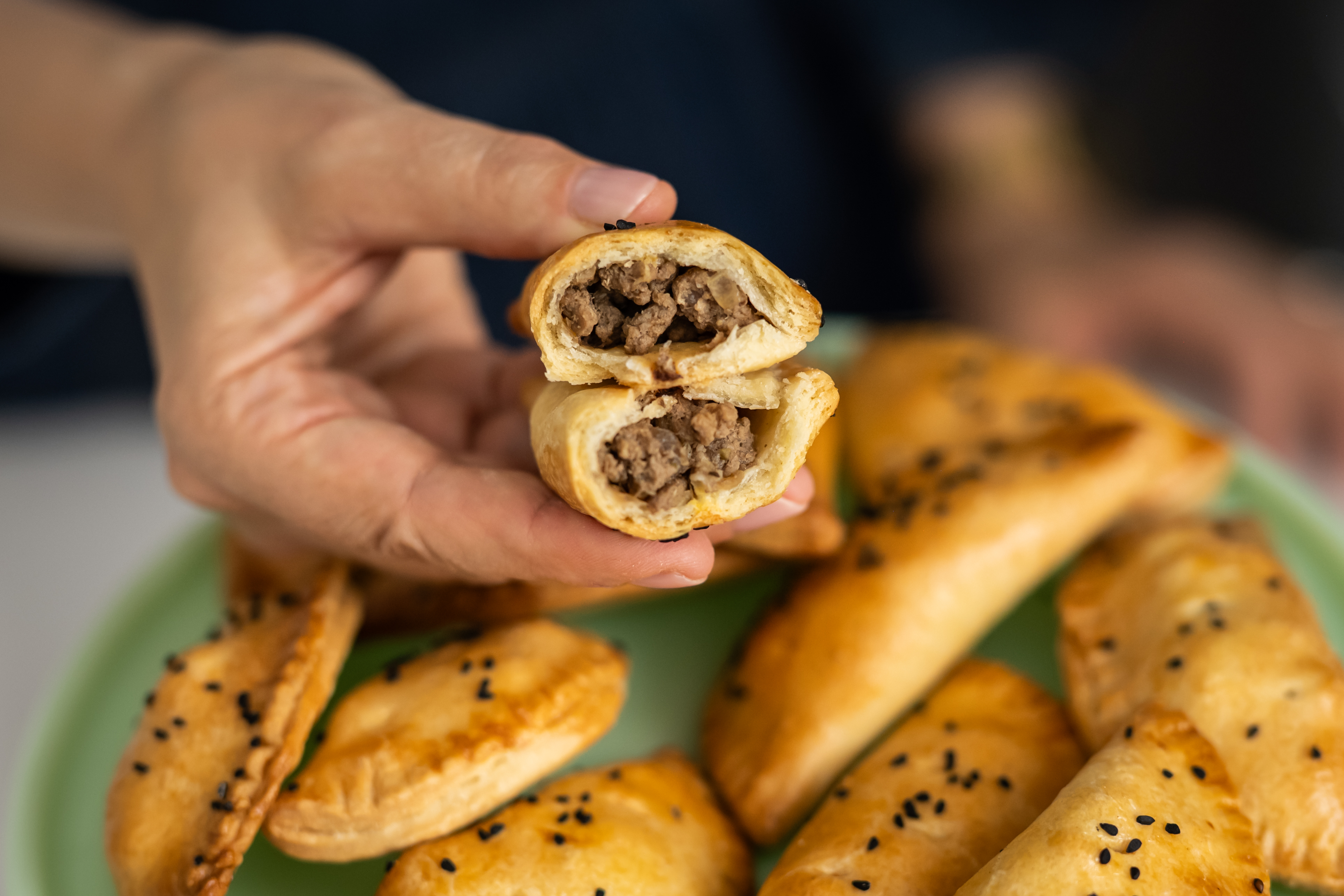
Makes 12–15 medium-sized empanadas
Though many think of empanadas as South American savoury handheld pastries, they are in fact originally from Spain. The author of the Shulchan Aruch – Rabbi Joseph Caro (1488–1575) – writes about empanadas in his treatise on Jewish law.
Empanadas travelled east with the Jews fleeing the Spanish Inquisition, and many say that these savoury treats are the forebears of bourekas as well as sambousek. Jews particularly favoured them because the filling was usually dry, which meant they could be reheated on Shabbat without transgressing the prohibition of cooking on Shabbat.
Empanadas were most probably brought to the New World by the Conversos who sailed across the Atlantic with the Conquistadors. One of the legacies of those brave Jews who settled in the New World is that most empanadas are made with beef rather than pork.
The version here is a bit more ‘child friendly’—I left out the traditional hard-boiled eggs, potato, currants, and olives, in the hope that my kids would love them. They do! But if you want to go traditional, feel free to add those authentic touches.
INGREDIENTS:
For the filling:
- 2 tbsp (25g) olive oil
- 1 medium onion, finely chopped
- 2 cloves garlic, minced
- 1 tsp oregano
- 1 tsp cumin
- ½ tsp salt
- ¼ tsp black pepper
- 400g (14 oz) lean minced beef
- 240ml (1 cup) beef (or chicken) stock
For the dough:
- 125ml (½ cup + ½ tbsp) olive oil
- 125ml (½ cup + ½ tbsp) warm water
- ½ tsp salt
- 375g (3 cups) plain (all-purpose) flour
For assembly:
- 2 egg yolks
- sesame seeds/nigella seeds/poppy seeds (optional)
METHOD:
Make the filling:
- Heat a medium sauté pan over medium-high heat. Add the olive oil, then the onion, and cook until softened and golden brown, about 10 minutes.
- Add the garlic and cook until fragrant, about 30 seconds. Stir in the oregano, cumin, salt, and pepper.
- Add the minced beef and cook until browned all over. Stir in the stock and simmer until most of the liquid evaporates but the mixture is still moist.
- Allow the filling to cool completely before using.
Make the dough:
- In a medium bowl, combine the olive oil and water. In a separate bowl, mix the flour and salt. Gradually add the flour mixture into the liquid, stirring until a soft dough forms.
- Knead the dough a few times until smooth and elastic. Use straight away, or wrap in plastic and refrigerate for up to 2 days. If chilled, knead briefly to soften before rolling.
Assemble the Empanadas:
- Heat the oven to 180℃ (350℉). Line two baking trays with parchment paper.
- Divide the dough into quarters. Roll out one quarter at a time on a clean surface (no extra flour needed, as the dough is oily) until very thin, about ⅛ inch (3 mm).
- Using a 13cm (5 in) cutter or small bowl, cut out circles. Place a generous tablespoon of filling in the centre of each.
- Brush the edges with egg yolk, fold into half-moons, and press to seal with a fork or your fingers.
- Arrange on the prepared trays. Re-roll scraps as needed—none should go to waste.
- Brush the tops with egg yolk and sprinkle with seeds if using. Bake for 30 minutes, swapping trays halfway, until golden brown and cooked through.
- Serve: Serve warm or at room temperature.
MAKE AHEAD:
- Refrigerate unbaked: Assemble the empanadas (without brushing with egg yolk) and place on a tray. Cover well and refrigerate for up to 2 days. Brush with egg yolk just before baking.
- Freeze unbaked: Place assembled empanadas on a tray and freeze until solid, then transfer to a freezer bag or container. Freeze for up to 3 months. Bake straight from frozen at 180℃ (350℉) for 35–40 minutes, brushing with egg yolk before baking.
- Freeze baked: Cool completely, then wrap well and freeze for up to 3 months. Reheat in a 160℃ (325℉) oven for 15–20 minutes until warmed through.