
& Small Histories
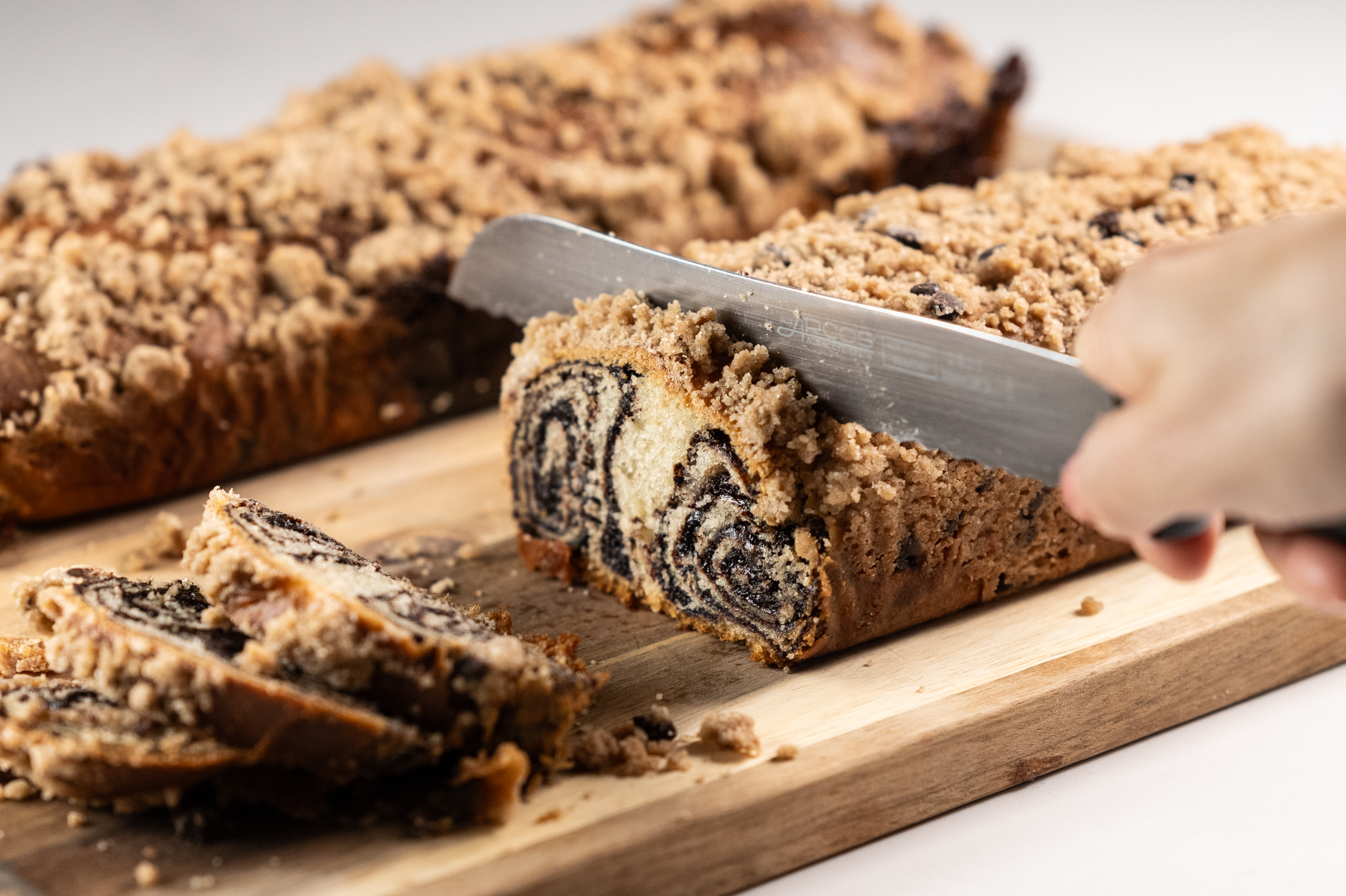
It’s hard to imagine that a cake, which you can probably buy in most Western bakeries today, was virtually unknown outside of Jewish bakeries in America and Israel until the 1950s. It took a 1994 episode of Seinfeld to bring it world renown. In the last 10 years, everyone has jumped on the babka bandwagon, and every respectable food content creator has their own version.

The history of babka is fairly well-known. Yeast cakes were part of the German kitchen, both Jewish and non-Jewish. When Jews migrated East, they took the yeast cake tradition with them. Babka, from the Polish for grandmother, evolved from being made using challah dough to being a standalone cake. From a simple cinnamon-sugar filling, it evolved to being filled with nuts, cheese, fruit, and, of course, chocolate. The dough transitioned from dry and bread-like to tender and cake-like. Babka went from being a Shabbat morning treat to an everyday purchase, available in every bakery and coffee shop, something to enjoy with a cup of coffee on a random Wednesday afternoon. These evolutions took time, as most things do, and I’m guessing that a 19th-century Polish grandmother – the namesake of the Babka – would not recognize our overfilled, tiger-striped cakes brushed with sugar syrups and streusel toppings as the modest yeast cake she made for her family as a Shabbat morning treat.

Though I love offering sweeping histories – the ability to see the great arc of where we came from to where we are going – even better histories are when I can tell you about a person whose life impacted, even in small ways, the course of events and thus our lives. With babka, I can’t offer a sweeping history or even an individual one. Rather, I will try to reconstruct a slice of life (pun intended).
In the work I do with Holocaust Education, I have had occasion to speak to a number of Holocaust survivors. Their stories are always humbling, moving, and their resilience is inspirational. These are the stories we ask them to share with students, these are the testimonies we ask them to bear. The saddest and hardest part of most of their testimonies is hearing that many of them can’t remember their mothers’ faces. No picture remains, not a physical one and not in their minds. Survivor Josef Lewkowicz told me with great pain, “I can’t remember her face, but I know she was beautiful.” It was his mother’s advice “to be nice to everyone” that sustained him through the travesties and trials of six different concentration camps. Yet when I asked him about her food, about her kitchen, he lit up. He told me of the mini challah rolls she baked every week and how she would distribute them to all the poor people of their village in Dzialoszyce. He could accurately remember their size, their brushed golden finish, and the aroma of fresh-baked bread every Friday.

Ben Lesser told me of his father baking pretzels at the start of the war. As the Nazis stripped away his means of livelihood, Ben’s enterprising father – given a bag of flour and having access to an oven – started making pretzels as all he needed was flour, water, and salt. Ben, as a twelve-year-old, remembers watching his father turn the small kitchen where they were living into a makeshift bakery that started producing simple baked goods. What Ben remembers best, though, was the mandelbrot his father made. Later, when Ben’s Shoah Foundation was struggling economically, he proceeded, together with his daughters, to recreate his father’s mandelbrot. “I remembered that when my father needed money, he made mandelbrot, so I would do the same.”

History and memory are not the same thing; yes, you need to remember to share history, but do you need to feel to share a memory. I see it all the time on the face of anyone I talk to about food. Their facial muscles change, their entire posture does. The histories they share often come from a intellectual part of the brain while their food memories come from somewhere far deeper, from calling on their sensory experiences to bring up the memory. When they speak of food, it’s about a sense of color, smell, taste, and often feeling.
What are the values of these small memories in telling big histories? Often in the bigger histories and even in the personal ones, something essential is lost. In the big ones, we rarely feel the impact of huge decisions and moments on the feelings and senses of individuals. And in individual histories, the individual is often remarkable, that is why their story has survived, why we still tell it. Or there was something remarkable and unusual that happened to them. In Auschwitz I, there is an image of a Polish prisoner, a girl of 14; her name is Czeslawa. Why do we tell her story amongst the images of so many others? Why do we know her name? Because there is something remarkable in her; look at the way she stared directly at the photographer; she was a child staring down her aggressor.

But what of everyone else? Those who were not remarkable to history but important to their families, to their communities? Those who did, in fact, become numbers, no matter how hard we have tried to give them names? Their stories are often lost or simply not remarkable enough to remember. I want to share with you an unremarkable story, a story of an ordinary life, of an ordinary village, like any of the thousands of villages around Poland where Jews had lived for centuries.
In this unremarkable home, the kitchen would have been the hub of the family; it would have, in many cases, been the only main room in the house. Unless you were affluent, and most weren’t, the main room contained the rudimentary makings of a kitchen: a few tables that would have been the kitchen surfaces, a cold box if you were lucky and had access to ice, a basin that you could fill with water from a pump outside your home. Dishes, though; you would have had two sets, one for meat and one for milk. You may have had a gas fire, but more likely, you cooked on a wood-burning stove. In terms of baked goods, most families at the start of the 19th century didn’t have ovens; it would only be when gas could be pumped directly into homes that many would have ovens towards the middle of the 19th century. Until then, they would take their ready-prepared doughs and cakes to the bakers’ oven where they would pay a few pennies to bake their daily bread.
And what of the modest Polish babka? This was a real treat. Families in shtetls were so poor that to have beautiful white challahs for Shabbat would have been a treat, something the family would save up for all week. To then take a bit of that dough and fill it with cinnamon and sugar and serve it as a cake on Shabbat morning would have been an extra special treat.
In my mind’s eye, I can see excited children dancing around their mother as she thinly rolled out the dough and carefully sprinkled cinnamon sugar on the doughy rectangle, ensuring that not even a bit escaped. Tightly rolling up the dough and delivering it to the bakers’ oven along with the challah the family would need baked for the Shabbat ahead. I’m excited for the family as they smell the freshly baked bread and cakes, coming back into the house, filling the house with that special Shabbat smell. The anticipation, in many ways, better than the treat itself. I want to sit at the table with them as the first slice is cut, and the youngest tears apart ever so gently their slice of babka, as the mom sits for the first time that week, eyes closed, taking in the noise of her family around her, and enjoying a moment of peace while wrapping her chilled hands around a cup of tea, withholding her slice of babka until everyone has had one.
These are the unremarkable stories that happened in every household, the ones we have lost, the ones that we can only imagine. But each time we bake and remember the origin of these cakes and then serve them to our family and friends with an open heart, we once more recreate these unremarkable histories of ordinary people living ordinary lives, not in any way mundane, rather in every way real.
Two New recipes for the week, Babka for a Crrowd and Mandelbrot. neither is difficult to make, but babka making does require a couple of steps and is time consuming rather than difficult.


