
Blog; January 7, 2024:
Two Fridays ago, we thought we were driving down to Gaza; we had already done so on Wednesday evening to pick up our son, who had been in Gaza for three weeks. We hadn’t seen him since July and hadn’t heard from him in three weeks, save for a two-minute phone call the previous Saturday night. There have been soldiers who have been in Gaza for longer stretches and some for shorter, some who have done more and some who have done less dangerous things than our son has been doing. Please understand; I have no idea what he is doing while he is in there.
That Wednesday evening, we got in our rental car and drove with one of our daughters-in-law down to the Gaza Envelope: an area that comprises, as it sounds, many small kibbutzim and a couple of towns such as Sderot and Netivot that surround Gaza as an envelope would. We were told to drive down to the junction of Nachal Oz. We had been at the same junction just over a year ago when the same son celebrated the Shabbat just before his wedding with our daughter-in-law’s adoptive family, who live on the other side of the Junction from Nachal Oz in Kibbutz Sa’ad.
I remember that Shabbat so clearly; it was Shabbat Chol HaMoed Sukkot, and we ate outside in the sukkah. After lunch together with Tamar, our daughter-in-law’s adoptive mom, we went for a walk to visit the kibbutz’s impressive cactus garden. Casually, Tamar pointed out the bomb shelters that she, her children, and the rest of the kibbutz members used often, as they have 9 seconds to hide when the siren goes off. Just as casually, she pointed at their fence, saying, ‘you see there, that is Azza.’ Azza (the Hebrew pronunciation for “Gaza”) is just three kilometres away from Sa’ad. Tamar and her family are among the 250,000 Israelis who are displaced, living with their four children and dog in two hotel rooms at the Dead Sea, having been told that the chances of returning home before Pesach are slim to none.
Why, you ask, do they not go home? The army is there now; surely, it is safe? It isn’t. Last week, the Sephardic synagogue in Saad got a direct hit from a rocket. Miraculously, the Torah scrolls survived, but where the building once stood, today there is a crater.
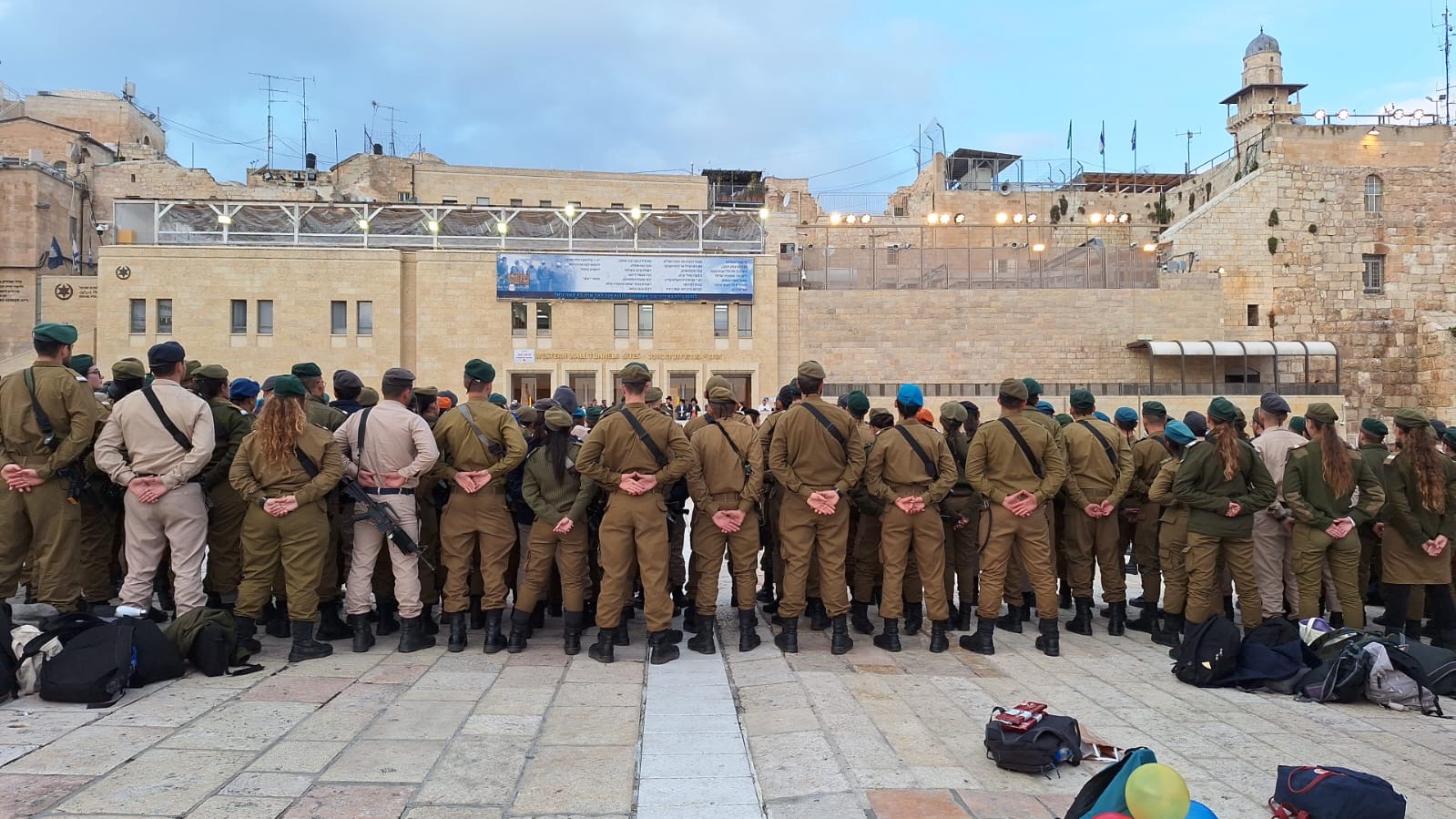
Last Wednesday, we stood the three of us at the junction of Sa’ad and Nachal Oz. We were all anxious, unsure what to expect. Unlike all the missions we have seen going down to bear witness, we had a simple task: pick up our son and husband. As we stood at the junction, we heard bomb after bomb, rockets – ours going off in Azza. One of my nephews is currently down there on the team that sends those rockets. The rockets preceded machine gun fire; we were close enough to hear them shooting and others shooting back. The soldiers guarding the junction didn’t even flinch; to them, it is just this alternative life they have been living.
From Nachal Oz, we were directed to another location, and from there to a third; it felt like a high-level scavenger hunt for our son. We willingly, no questions asked, drove from location to location, eagerly anticipating seeing him and hugging him. About an hour after arriving, we saw him sitting on the back of a Humvee, in full gear from head to toe – helmet, breastplate, knee pads, boots, all in a dull green that blends into the surroundings. After a quick hug from the back of the Humvee for his wife, into the base he went. A half-hour later, all the gear was done, he came out, just him and a bag of laundry. And then, after a big hug for his gorgeous wife, a hug for us.

Our son has lived in Israel since 2018 and been in the army since 2020; he’s been in dangerous situations prior to this. We have gone longer without seeing him, but I don’t have to tell you that this feels different, we currently feel that every moment we have with each of our children is beyond precious.
Israel is hurt. On the outside, it all kind of looks the same, Israel as it has always been: cafes filled with people, traffic everywhere, children being taken to and picked up from Gan, high-tech people “high-teching”, and people praying and going to the beach. Kids on their gap year, Jews, Muslims, and Christians, ultra-Orthodox and secular, right and left, all existing in the same space. And yet, you needn’t scratch the surface too hard to find the Israel of this moment; it isn’t below the surface, it is the surface. What we are seeing is the mask they have put over the surface. People are traumatized. Not three months ago, thousands of terrorists intent on murder, rape, and mutilation streamed into their country and were successful in their satanic mission, doing the worst things one human could do to another, and got away with it, as far as the people here are concerned.
They were told they were safe; they were told that they lived with enemies all around them, but also that they had best intelligence in the world, the best defense mechanisms known to man. Yet, on October 7th, the incursion no-one anticipated did happen, and in that moment, the people, not just of the south but up and down Israel, were attacked; they all felt vulnerable. They are traumatized, and collective trauma like that needs to be addressed.
We saw a woman sitting on the grass outside the King’s Hotel in downtown Jerusalem; she held a small placard that said only ‘bring him home,’ not ‘bring them home.’ It beseeched people walking by that her ‘him,’ an individual, is not home with her. She isn’t being held in ‘his’ arms; they aren’t having coffee together or arguing about the bills. I wanted to talk to her; as I walked up to her, I was thinking, what could I possibly say? I approached; she was on the phone, bent double, crying. I walked away because even in the middle of an open town square, she deserved a bit of privacy. I stood aside and just watched her; soon, her phone call was over. She must have been in her late fifties, but even so, she curled herself up, drawing her knees up to her chest, wrapping her arms around them, head tucked in, and silently rocked herself. I left her alone at that moment because all I could feel is that the only person to give her comfort is herself.

Israel is traumatized, and it needs to heal, but that healing will only come from within. For us, Jews living outside Israel, we will send the money they need. To date, American Jews have sent over a billion dollars. We will send missions of solidarity; while we were there, we met a mission of 40 people from The Jewish Center in the Upper West Side of New York. Again, they will offer exactly what they said they would: solidarity and friendship. But the real healing will have to come from within. Like any good therapist will tell you, the only person who can heal you is you.
That Friday, instead of driving down to Azza, we drove to Ra’anana. Our son didn’t need to be back on base until four, so he was going to get a ride with another person on his team back to Azza. Instead, we sat eating the best hummus I have ever tasted from a hole in the wall eatery on Achuza Street. The line for hummus extended down the block. People in Israel do not want to be at war; nothing could be clearer. They want to stand in line to buy hummus on a Friday; they want to be with their family and friends. They want to be doing as they have done since the first dreamer dreamt of Israel; they want to build a home, and they want to feel safe in that home. The illusion of safety has been taken away from them, and the future will be about bringing that safety back to the country, back to each city, back to each kibbutz, back to each home, and each person. And the only way this is going to work is as Israel is already doing. Israel will take the initiative and restore and ensure its own safety.

And once more, back to food:
As I keep on reminding myself, this is a food blog! But food and life cannot be separated!
Over the last couple of weeks, I have broken down my system of how to prepare a menu, a shopping list, and then how to organize our time. This week, I was going to get into the basics of smart cooking, but in truth, I almost skipped the part where life happens, as it is happening to me at the moment. My system works brilliantly when life goes according to plan, but how often does that actually happen? For example, I have been traveling non-stop since the 13th of December, and we are now one week into January. This Shabbat, not only am I hosting, but I’m actually hosting a family of 6 for all of Shabbat, which takes loads more planning than just a single Shabbat meal. There are beds to be made, Friday night dinner, some kind of breakfast, Shabbat lunch, snacks, and games all to be organized. On top of that, I have work I have been putting off for weeks to catch up on. Suffice it to say, no menu has been written, no shopping list put together and executed, and the freezer is empty. What to do? As this is the reality most of us face, I wanted to take some time to share some action points that help me:
- How much time do you really have? Are you going to be working on non-kitchen, non-food-related stuff until the minute before Shabbat, or do you have a couple of hours between now and Shabbat to do a couple of things?
- If you don’t have a minute between now and Shabbat, delegate! And by that, I mean when things are calm-ish (if that ever happens), if there is a place in your area that sells ready-made Shabbat food, put together a menu based on what they sell, have it ready. For me, it’s Manna Deli in Hendon. They rarely change their core menu, and I have a list of my ‘usual’ order. I send it to Ruth, the amazing owner and chef of Manna, and I just let her know how many people I’m feeding per meal. On these super busy weeks, my husband will often have time to pick up the food, but if he is under his own pressure, Manna Deli will put the stuff in a taxi and add Challah and Wine to the order if I ask them to. This is all about building relationships and knowing when to say you need help.
- On the other hand, if you do have some time to dedicate to Shabbat preparations, decide what are the one or two dishes that your family prefers are homemade versions. Or it’s one of those things that you can’t buy. For us, it is chicken soup and cake. Both can be easily bought, but my family prefers the homemade version of both. So whatever time I have, I will dedicate to making those items that we prefer to be homemade.
- Know what you can buy and what you can’t and know when to ask for help: We were in Israel last week and I did a combination of buying ready-made food and making our own. In terms of ready-made things, I knew I could rely on loads of fried things and lots of different small salatim (salads) and olives, as well as dried fruits and nuts.
- Use the limited time wisely: Divide and conquer. Asking for help is key. Others can also shop or cook. All you need to make this work is a menu that you share with others and knowing that most often, people want to help. My mom made the chicken soup, my sister-in-law made cake and cookies, my husband made the brisket, and I made the chicken while my mother fried the potatoes (we made Chicken Sofrito)

I often ask my productivity students, what is the goal and what is the system? The goal in my case is to have a beautiful Shabbat. What are the elements of that Shabbat? To me, the most important element to achieving a beautiful Shabbat, is to reduce stress. Putting together a meal for 14 people or more twice over Shabbat can be, and often is, stressful. Some weeks it doesn’t faze me, and I am organized. I take it all in my stride and get on with it. On other weeks I have no time, and the only thing I want to do is sit down and give myself a rest. Yet, as part of my role as a Rebbetzin, I will more often than not have to host. In those moments, I need to be honest with myself, what can I do and what will I delegate?
Here are some of the rules I live by:
- Sometimes, it is about you: People are here to spend time with me, not my food.
- It’s okay to buy: Though my homemade food is delicious, most people are equally happy with the store-bought stuff.
- Show them you love them: I express my love for my family, friends, and community through food. Therefore, not cooking for them may feel like I’m not showing them love. In those moments, I can use my words rather than a steaming dish. Or equally, in those moments, I need to conserve my energy so I can show them I love them even more, but in a different way: that I love them enough to look after myself.
- Delegate: Most people like to be asked to help in some way. Be it to bring a bottle of wine with them (it’s one less thing to worry about) or help clear the table. Unless asked, most people don’t actually know what to do.
- Create systems: Notice what works for you and what doesn’t. In the quiet moments, look back and notice what happened over Shabbat, what worked and what didn’t, who can help and who can’t, what dishes people didn’t touch and what dishes did they lick the bowl clean. What required more energy than you expected and what didn’t? Do not trust recipes (even though I say this all the time in mine) that say ‘it takes no time’ to do this or that; it’s only your own experience that counts here. And then adapt what you know to your plan for the following weeks and months to come. The reason people who make Shabbat often seem to do so quickly is that they have often created systems that work for them. This is why you hear people on the radio panicking before serving a Christmas meal for 8 people. It’s not because it’s hard; it’s because they don’t do it often enough to have a system. It’s the reason magazines give readers ‘game plans’ on how to tackle cooking the ‘big meal,’. The reason is that for many of us who are traditional Jews, cooking ‘the big meal’ happens weekly, and because of that, we will often create systems that make it manageable. Week in, week out. What are your systems? What is working for you and what isn’t? If it isn’t working, why not? And what can you do to improve or update the system?
Next week we will dive deeper into systems – truly my favourite part of planning!
One New Recipe for the Week:
