
My Family: a family of bakers and keepers of tombs:
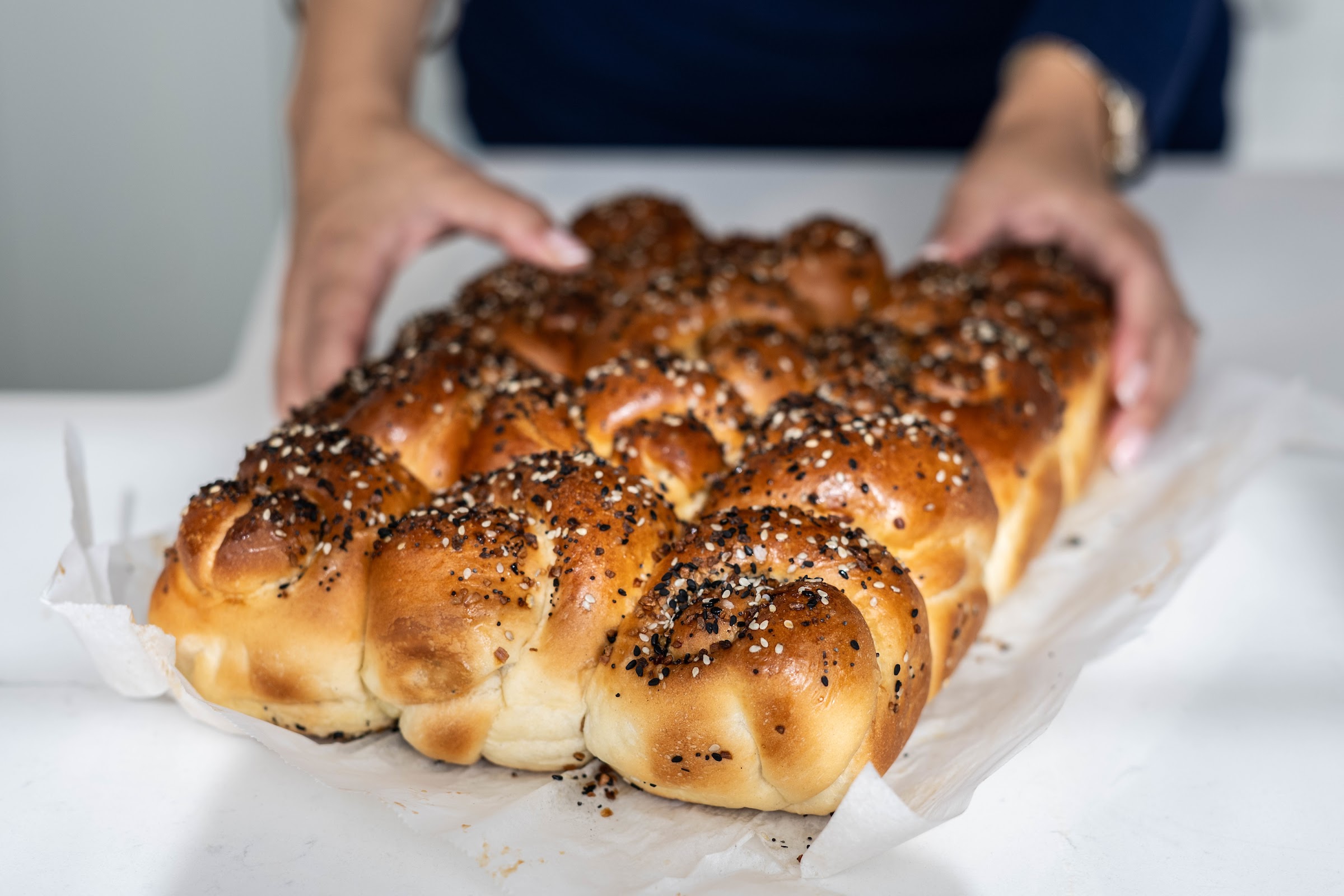
Click here for my new challah recipe (pictured above).
When Napoleon said that an army marches on its stomach, did he know my People?
Aside from the pure evil we are witnessing, our daughter Odelle, who has been volunteering all around Jerusalem, has mentioned that she feels the entire country is focused on food. Odelle has noted that every aspect of her volunteering revolves around food. She and her friends are packing food parcels for the soldiers, cooking at soup kitchens and baking bread.
The Savta (grandmother), who saved herself and her husband by baking cookies for the terrorists who sat at her kitchen table, has become our new national hero.
Our son Y., a soldier in the IDF, has expressed that he has never been so full in all his life.
The images I try to hold onto when the horrible ones invade are those of Jews of all backgrounds waiting at road junctions, handing out food to every soldier who passes by. The image of a restaurant in Tel Aviv making its kitchen kosher so that all the soldiers could enjoy the food they were preparing.
The tent city that has been set up in the army base in the South of Israel that runs a round-the-clock barbecue, ensuring that soldiers can grab a burger at any time of day or night.
There is also a video showing people baking gluten-free bread when the Israeli bakery ran out, ensuring that celiac soldiers have something to eat.
I think about food and Judaism a lot, sometimes as a unit, and sometimes on their own. Since October 7th, I have exclusively contemplated what it means to be a Jew in this world. I’ve thought about my family a lot, the majority of whom live in Israel, including three out of my four children, my daughters-in-law and my grandson. I have reflected on pain. I have seen photos and videos that shocked and horrified me, even though I am a Holocaust educator; I should be immune. I have thought non-stop about London buses (I will explain) and have had thoughts about bread.
The first few things are obvious: the Jewish people are in shock. We haven’t processed enough. Our children, our sons, our daughters, our parents, our friends…
Who. Should. Not. Be. On. The. Front. Line. of a war are oscillating between every emotion there is.
As Micah Goodman said in his podcast (listen here), we are holding onto a cocktail of emotions. Life in Israel has shifted from the regular everyday to a minute-by-minute stimulus followed by action.
And outside Israel, we watch.
We are dealing with the antisemitism swirling around us. A young woman tells us that every single action committed by Hamas was entirely justified, while wearing earrings in the shape of M16s. A professor from Cornell says he was exhilarated by seeing Jewish babies being violently and inhumanely murdered, while others cheered him on. However, despite how deeply this affects us, our hearts are collectively in Israel, and we ping-pong between their pain, their reality, and our filtered version of reality outside of Israel.
Let me tell you about bread, especially challah. From a wheat seedling to the beautiful challahs that grace our Shabbat tables, every aspect of challah feels like we are in control. Even if, as in Israel, there may not be enough rain one year to help the grains grow, we have the most advanced irrigation systems in the world, and thus we almost always have access to wheat, through man’s endeavors. We are in control from the beginning of the process until the end, laboring to make our daily bread. We invest all our creativity and energy into making a loaf of bread (substitute the word ‘bread’ with anything you create – from art to income), and we do it daily.
In Jewish bread making, as long as you are using over 1.660 kilos of flour, we follow a positive biblical commandment (mitzvah) called ‘separating challah.’ It is from this mitzvah that our Shabbat bread gets its name. For bread to be considered kosher, a portion must be separated from it, and a blessing is made on the portion separated.
I ask you, why? Why does God care if you separate a small portion of dough from the mass? Unlike many other commandments we adhere to, it seems pointless. I can understand switching off my phone for Shabbat – never more so than at this moment. Eating kosher, another commandment, though its laws may seem a bit arbitrary, I can rationalize. But this mitzvah seems pointless.
I have come to understand it as follows: just as God does not need our prayers or our observance, so too God does not need the separation of a small portion of dough. It serves God no purpose. The purpose is for me, you, and humanity to understand what all our soldiers, friends, and family in Israel understand at the moment. Even if we put in our blood, sweat, and tears – and there has been way too much blood and an ocean of tears – ultimately everything is in God’s hands. We may make the bread from seed to table, but our creativity, our energy, our abilities are God-given gifts. We separate a small portion of dough, make a blessing, and dispose of the dough because in the moment of doing, we hold onto the thought that this world, from the blade of grass swaying in the wind to the machinations of evil, is in God’s hands. That doesn’t mean we put up our hands and give up, hide under the blanket until it’s all over, (though I can assure you, so many of us want to do just that). What it means is that we put in the effort, confront evil, fight for life and for what is right. But know that ultimately Hashem is the one in charge.
My relationship with bread goes way back. If you would like to read more about it, keep reading. But for now, my message is to bake, put all your energy into making bread, and remember that ultimately God is in charge.
This brings me to London buses. I have three children in Israel, two beautiful daughters-in-law, and a precious grandchild, my parents, my siblings, my cousins, nieces and nephews and friends. Every time my anxiety rises, I think of London buses. The week before I married Daniel in 1996, I was nearly hit by a London bus; it was a close call. I think that if God wants one of his precious children back in his warm embrace, all it takes is a London bus; it does not take a war or a terrorist. My children are where they want to be, doing what they want to do, believing in their country and their right to live there, and my pride blossoms in that moment to a size that can’t be contained. My anxiety comes back down to manageable levels, and I get on with baking more bread. What is your London bus?
**********************************
Below, I share some of the long history of my family living for centuries in the Land of Israel. The relationship between Jews and Israel didn’t start 75 years ago; it started thousands of years ago. We have inhabited the Land continuously for over 3000 years, and some of my family has lived in an unbroken chain in the Land since the time of the destruction of the Second Temple and one would imagine before that as well. Read below just a bit of my family story and make it your own.
My Family: a family of bakers and keepers of tombs:
North of Jerusalem’s central bus station, there is a neighborhood called Shechunat Ha Bucharim (the Bukharan neighborhood). The construction of the neighborhood began with the Bukharan immigration to Jerusalem in the 1870s.
The Jerusalem of 1800 would not have recognized the Jerusalem of just 70 years later, much less the bustling city of today. A Friday morning in Jerusalem is an incredible experience filled with sound, color, vibrancy, and food – so much food! You can taste foods from around the globe, representing not just the countries that many Jews hail from, but also the countries young Israelis travel to and the taste of street foods they bring back with them. Yet, the singularly most prevalent food, on a Friday morning, on the streets of Jerusalem, is Challah.
Challah is the Shabbat loaf of bread. Small or large, doughy or dry, whole wheat or white, ordinary or artisan, you will find challah in every bakery, including in the bakery chains inside malls. Challah is everywhere you look. It is almost impossible to escape Shabbat preparations on a Friday morning in Jerusalem and, with bread like this, why would you want to?
The Jerusalem of 1800 occupied roughly the same 0.85 square kilometers as the preceding Roman colony of Aelia Capitolina, which was built in 132 CE. The Roman town was constructed over the Jewish ruins from the destruction of the Temple in 70 CE. The ‘modern’ Ottoman city was built over the Roman ruins.
The French traveler François de Chateaubriand writes of Jerusalem as he found it in 1806: a ‘labyrinth of dark, narrow, unpaved, and dusty streets, lined with empty shops and houses. Even the better neighborhoods were desolate and filthy. A mass of square windowless stone houses, whose flat terraces and occasional domes made them look like prisons or tombs.’ When my Ashkenazi forebears arrived in Jerusalem in 1809 (I will write more about this part of my family in the weeks to come), the scene that greeted them was nothing like the Jerusalem of their prayers back in Lithuania. Early 19th-century Jerusalem looked to those pious Jews like the Jerusalem described by Jeremiah in Lamentations (1:4): ‘The roads of Zion are mournful because no one comes to the appointed season; all her gates are desolate, her priests moan; her maidens grieve while she herself suffers bitterly.’
By the time some of my Sephardic ancestors (most of my Sephardi ancestors have lived in Israel from time immemorial) settled in Shechunat Ha Bucharim, probably 70 or 80 years after my Ashkenazi many-times-great-grandparents arrived in Jerusalem, the city had shed its shrouds. Building outside the Old City walls was underway. New neighborhoods were springing up to the north, east, and south of the Old City, taking the population from less than 10,000 in 1800 to 35,300 in 1883. Jerusalem became a destination for European travelers. Thomas Cook led his first Palestine Tour in 1869. Christian pilgrims would swell the population numbers during the Easter celebrations. Between 1864 and 1889, the streets of the Old City were paved, and by 1890, the regular cleaning of the paved streets had commenced.
My great-grandfather Shalom Mizrachi’s family are called Baghdadi Jews, the last leg of their journey to Israel was from Baghdad, Iraq. The Mizrachi family built a small community bakery in the wide streets of Shechunat HaBucharim (even though they were not of Bukharian descent, they settled in the neighborhood, as did others), among the mansions and the more humble dwellings. They proceeded to industriously and continuously provide their customers and neighbors with bread.

The Jewish population of 19th-century Jerusalem by and large lived in abject poverty. Most lived cloistered together in tenement buildings with central courtyards where children could play and hopefully not roam the dusty streets. The perils of 19th-century Jerusalem didn’t just come from the hostile neighbors but also from the wild animals that roamed the streets, the open areas where no inhabitants lived, and the unsanitary conditions. Mortality rates were high, especially among infants, due to the lack of clean water and basic sanitary conditions. By all accounts, it was not an easy life. Neighbors found security in communal living. In those cramped conditions, it would have been unusual for people to have domestic ovens. The reliance on the baker to supply daily bread was a fact of life and has remained so throughout most of history.
At around the same time as the Mizrachi family was baking bread in Jerusalem, a man named Yichye (Haim) Asbat was traveling the trade routes which Jews had established over millennia. His travels would have taken him from one established Jewish community trading post to another. The theory is that Asbat was either a trader or a craftsman, making a living the way Jews had done from time immemorial, trading in valuable merchandise. At the same time, he was acquiring knowledge and information, hearing as well as passing on news along the trade route. When we first hear of Asbat, he is in Aden, the prime trading post of the Persian Gulf. From Aden, he traveled to Turkey, where he married. Together the couple traveled to Bombay, India, and settled within the Jewish community there.
Yichye Asbat, according to my great-aunt Sima, was employed as a chef by one of the local Rajas. Unfortunately, Asbat’s wife soon died in childbirth. Bereft and left looking after an infant, Asbat took to the road once more and traveled to Jerusalem.
In Jerusalem, he met up with the Mizrachi family, the bakers of Shechunat ha Bukharim. We don’t know if there was a relationship prior to this meeting, but one would assume as much. The head of the family, Shalom Mizrachi, together with his wife and children, took in Asbat’s young child and raised him as their own. Shalom in Hebrew means peace or hello; in both cases, it is a welcoming greeting, and Mizrachi, from the root ‘mizrach’, meaning ‘East’, was the last name that many Jews who made Aliyah from the countries in the Middle East or ancient Ottoman Empire took on themselves. The name is poignant. This man, Shalom Mizrachi, and the little we know of him can be encapsulated by his name. He welcomed an orphaned child into his home, and his identity was tied to the Land of Israel. Mizrach (East) is also the idea that Jerusalem is in the spiritual East, and that our souls long for it, is a long-held Jewish tradition (since the destruction of the Temple in Jerusalem). Living in Jerusalem wasn’t just an aspiration for him but rather a fulfillment of his purpose as a Jew.
The orphaned child was raised in the baker’s home and eventually married the baker’s daughter. When the couple had their first child, they named him Shalom Mizrachi after the girl’s father, and the boy’s adoptive father and savior.
Shalom Mizrachi the Younger, growing up in the bakery in Shechunat ha Bukharim, was born to bake. On top of his baking skills, he was also entrepreneurial. He traveled to Haifa, the busy port city which was starting to establish itself as a business center, and whose Arab population (which, at the turn of the 20th century, was 96%), was shifting. By 1945, the population of Haifa was 47% Jewish. In Haifa, Shalom wed Saada Amsalem, the daughter of one of the oldest Jewish families of Northern Israel, with a history and a lineage that stretched back for many generations.

Legend has it that Saada’s family were the keepers of the tomb of Rav Shimon Bar Yochai, a second-century sage whose opinions are written in the Mishna. Rav Shimon Bar Yochai lived in ancient Judea and was one of the preeminent students of Rabbi Akiva. He is buried in Meron in Northern Israel. My mother, as a young girl, remembers sleeping in the room above his tomb, as her mother and grandmother had been the keepers of the tomb. When the family immigrated to America in 1959, the key was handed over to a cousin.

As a wedding present to Saada and Shalom, Saada’s brother, Yosef Amsalem, a wealthy architect, gave the young couple a plot of land in the Lower Hadar neighborhood, an area close to the port of Haifa. It was one of the busiest ports in the Middle East and Shalom Mizrachi built a bakery on the land, the first Jewish bakery in the city since the 3rd century of the common era, when it was a small fishing village and a home to Talmudic scholars. They also built housing for themselves next to the bakery, and every few years they added another floor, with the intention of giving an apartment to each of their 5 children.
Their eldest daughter, Zahava, was my grandmother. Zahava’s first job as a young child was sweeping the bakery floor before leaving for school, at the famed Alliance Française. When she got older, her job was to take the family donkey to deliver fresh bread before running off to school. This donkey knew where to stop on the route and could find his way back home. Her father was doing well and opened a grocery store a few blocks further up from the bakery, closer to the growing Jewish areas. As soon as Zahava graduated from high school, she had to manage the shop, which was a full-time job. Besides attending to the customers, without a calculator, she was also responsible for keeping the shop in stock. One of her customers was a good-looking young man who worked at the port of Haifa. This young man became her husband, my grandfather Tzvi Rosental. Zahava managed incredibly well and quickly learned the languages of all her customers; she was already fluent in Hebrew, Arabic, English, and French, but she soon picked up Ladino, Yiddish and German as well.
When my grandparents married, a story all its own, my grandfather left his Ashkenazi family in Jerusalem and joined the bakery in Haifa. Baking bread would, in the future, also become my grandparents’ ticket to the American dream.
I often think of my love of baking not just as something I like to do because I enjoy the motions, the physical exertion, the aroma that fills my kitchen, or the act of separating a portion of challah which connects me to Jewish tradition. Far more than that, baking for me is a link in the chain, connecting me today to the family living in the dusty and dangerous streets of Jerusalem in the 1880s, feeling secure in their building but insecure about the future. The Jewish trader Asbat, who was the conduit in bringing his orphaned son to a warm home, and did a stint as a chef for a raja, must have been tasked with baking bread as well. I think about the first Jewish bakery in Haifa after millennia and I think about American dreams. Bread is, without question, an aspect of my forebears’ survival.
3 responses to “If Challah be the Food of Love, Bake On.”
Wow! This history of your family is truly fascinating, your love of cooking and baking is genetic too !
Nina x
What an incredible story!!! The richness of your history pours through your fingers each time you knead your dough with such love and passion!
From another challah baker!
Thank you so much!