
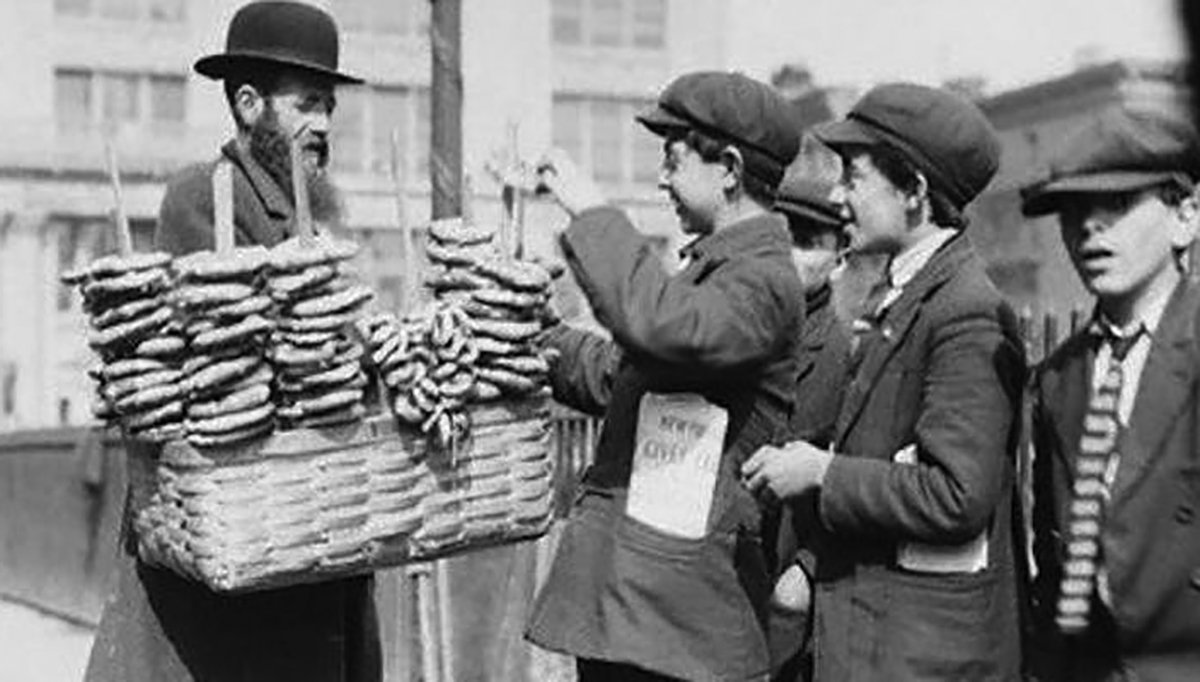
Daniel and I have spent the last week in New York City, seeing friends and family but above all it seems we have spent the week eating bagels! Every single day, I have managed to have a bagel, perfectly toasted, filled bagel. I thought I would share with you one of my favorite histories, the History of the Bagel.

We think of them as being ubiquitous – who doesn’t know what a bagel is? It’s hard to imagine but less than 100 years ago bagels were unknown outside of Jewish Ashkenazi circles.
As late as 1956 the New York Times tried to explain the bagel as ‘A Form of Jewish baked goods sometimes described as a doughnut with rigor mortis, will not disappear from New York tables.’
It is not the shape that is unique in the bagel. Ring-shaped pastries and bread are found throughout many cultures dating back thousands of years. What is unique in a bagel is that it is boiled before it is baked. The boiling step is what produces the characteristic crisp crust and chewy inside that we love in a bagel. On a chemical level, the boiling kills any yeast on the surface of the bagel and restricts it from rising during the baking. We will talk about the ring shape a bit more later. But if you think about it, the bagel is definitely related to the older medieval pretzel, which underwent the same boiling before the baking process.

The first mention of the bagel is in 1610 in the records of the Jewish community in Krakow. It states that a bagel is an appropriate gift for a woman about to give birth and for the midwives.
But logic would have the bagel appear on the Jewish table far earlier. There seemed to be a dictate in the 9th century in Germany that Jews were not allowed to bake commercially nor were they allowed to sell their baked goods to gentiles. This may have been one of the many reasons Jews left Germany and made their way East to Poland starting in the 11th century. In 1264 there appears an odd statement by the Polish Prince Boleslaw the Pious, stating that ‘Jews may freely buy and sell and touch bread – like Christians’ implying that prior to this it was prohibited. This was such a radical step that a Polish Bishop in 1267 forbade Christians from buying foodstuffs from Jews – hinting strongly that they contained poison for the unsuspecting gentile.

The theory has it that before the leniencies granted by Prince Boleslaw the Pious, Jews found a loophole. Bread that was boiled first and then baked could be handled by Jews and sold to the gentiles. Maybe necessity was the mother of the invention of the bagel?
By the time we hear of the bagel, in 1610, it is already a commonplace food among the Jews of Poland and the Baltic states. But they didn’t seem to travel far beyond Germany or Russia. The original bagel was smaller and thinner – Culinary Jewish Historian Gil Marks describes it as ‘more hole less bread’ than the modern bagel. In fact, the bagel was so important to Jewish life that it even was mentioned in the annals of the community.
The 16th and first half of the 17th century were the golden age of Poland and Polish Jews. Poland’s economy blossomed and the reason for that transformation was grain. Western Europe was looking for a cheap source of grain and, with its vast wide plains, Poland was it. During that time, Poland became Europe’s breadbasket with Polish grain reaching as far as Portugal and Cyprus. The grain was mostly rye and oats but, in very good years, wheat as well.
The cultivation of wheat brought prosperity to the Polish Jewish community.
- Noblemen looking to develop their estates turned to Jewish bankers.
- Jewish traders were sought who knew how to deal with international trade.
- A newly wealthy class emerged in Poland and wanting the finer things in life, looked to Jewish importers of citrus and wine.
- The vast properties especially in the east of the country (today Ukraine) needed Jewish administrators to make the most of their lands.
The population in the east of the country expanded tenfold during the Golden age.

But the golden age came to an abrupt end in 1648 when Bogdan Khmelnytsky, a leader of the Ukrainian peasantry, rose up and attacked. Though their fight was against the noble class and landowners, Khmelnytsky and his army took it to the people they saw benefiting from the growing wealth, the Jews. Tens of thousands of Jews were murdered, business and homes destroyed. In Jewish literature, this period is known as “Gezeirot Tach v’Tat” or the ‘Khmelnytsky Massacre”. Following the Khmelnytsky Massacre of 1648-49, which left the Jewish community of Poland devastated, bagels were served as breakfast and lunch for the masses of Polish Jews.
Unlike most of the bread in Europe, such as rye bread that was commonly produced in bakeries by professionals, the bagel was typically prepared in modest homes by women and then sold from baskets or poles on street corners by the children or husband. Officials in Poland on occasion tried licensing the selling of bagels, but most peddlers ignored them, frequently at the risk of forfeiting their bagels to the officials trying to license them.

Onto the shape – it was eminently practical if you wanted to sell a bagel from a dowel, or from a string around your neck. In the Brick Lane district and the surrounding area of London, bagels (locally spelled “beigels”) had been sold since the middle of the 19th century. They were often displayed in the windows of bakeries on vertical wooden dowels, up to a meter in length, on racks. But like anything Jewish, with time it came to be imbued with meaning and, its circular shape having no beginning or end, made it the ideal food for life cycle events, such as births, circumcisions and post-funeral gatherings. But despite its significance, a bagel has always been an everyday food. Working men and school children ate them on the go, plain or at most with a schmear of butter or shmaltz.
In the 1880s when Jews began to arrive in England and the US in great numbers, they brought with them the bagels. Peddlers went from the street corners of Polish cities to Petticoat Lane in London and the Lower East Side of New York. The West offered new possibilities, more space, and cheaper fuel. And bagel bakeries started appearing in both London and New York.

In New York, by 1907 there were 300 bagel bakeries. The bakeries banded together to create a Union. The group was so exclusive that membership was passed down father to son. Recipes and techniques were zealously guarded family secrets.
What started out as one woman making bagels in her Polish kitchen, became teams of four men making bagels: two men to cut the dough and shape it, one to boil, and one to bake. These bakeries were no more than cramped cellars and workers were paid per piece, an experienced team could churn out 6,400 bagels in one night shift.
As the Jewish immigrants became more established, bagels went from an everyday staple to a Sunday morning treat. And the advent of the bagel toppings started, from poppy seed to dried onions and, of course, the “everything bagel” topping.
In 1930s New York, the stylish Sunday morning breakfast was eggs benedict, but jews did eggs benedict their own way: they substituted the ham with lox, the hollandaise sauce was replaced with cream cheese, the muffin became a bagel, they got rid of the egg altogether and a Jewish classic was born! Neither lox, nor cream cheese had ever been associated with a bagel in Poland.
The bagel shop – in 1907 there were 300 bagel bakers in New York City, in 1994 1,400 bagel stores nationwide and by 1998 more than 9,000. There are today bagel shops in most towns in America including those with no Jewish population.

AIB reported US$626.9 million in fresh bagel sales in US supermarkets (excluding Wal-Mart) for the 52 weeks ending 11 April 2012. Fresh/frozen supermarket sales (excluding Wal-Mart) for the 52 weeks ending 13 May 2012 was US$592.7 million. The average price for a bag of fresh bagels was $3.27; for frozen it was $1.23.
I will leave the rest of the bagel story for another time. Suffice it to say there is so much more to this breakfast food than meets the eye!
Though some people may still acknowledge the Jewish roots of the bagel, most don’t really know how bagels have accompanied Ashkenazi Jews from the Rhinelands, to Poland and then to the new world. They encapsulate the story of us, from the lowest points to the highest and signify as they do at our lifecycle events, continuity and, above all, resilience.
If you can’t get an authentic Bagel where you live you can always make your own, here is a recipe I have been making for years, plus some other bagel inspired recipes – including bagel dogs and two types of gravlax!


