
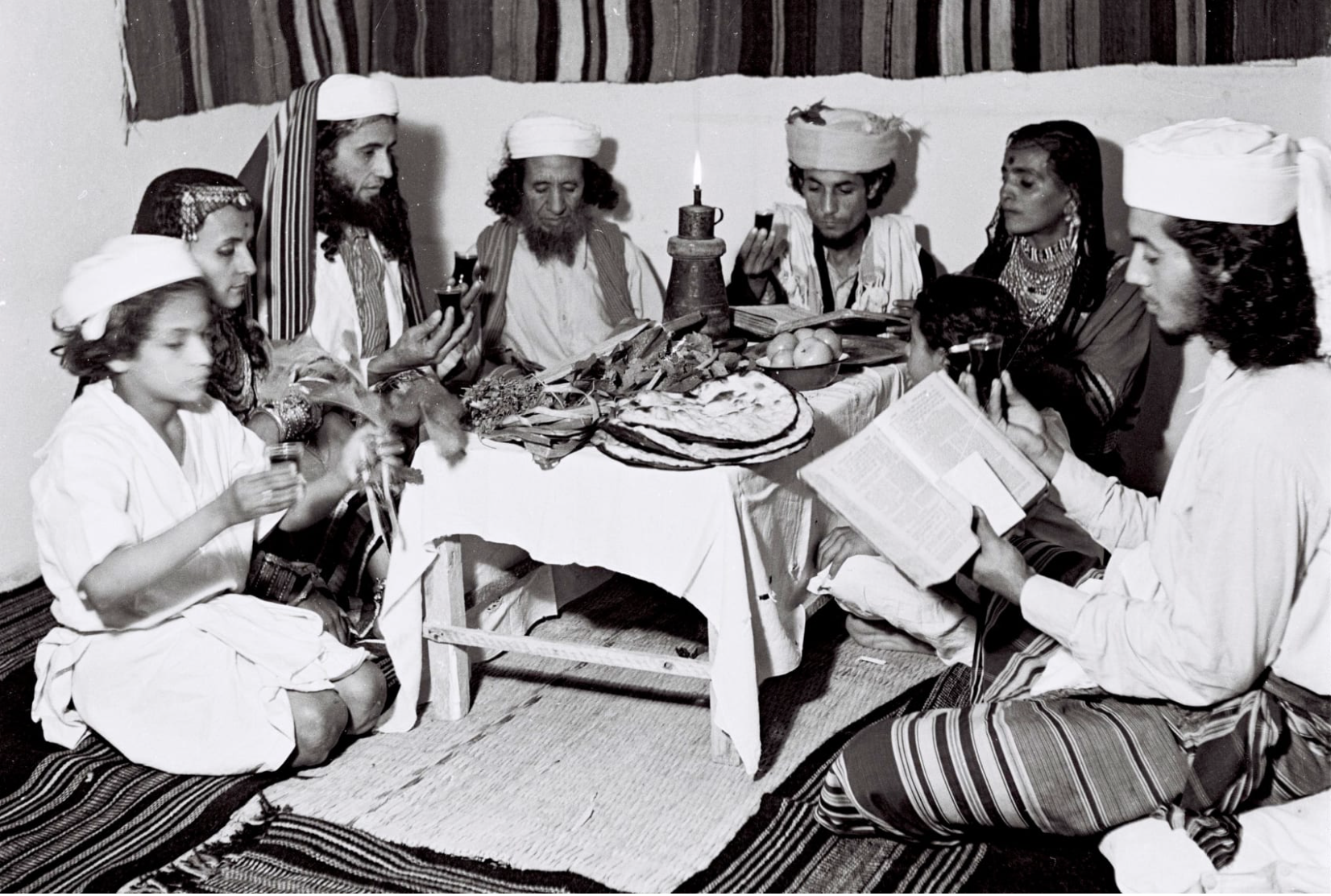
A Yemenite family celebrating the Pesach Seder at their new home in Tel Aviv in 1946.
Photo: Zoltan Kluger/Israel Government Press Office
Despite how difficult the last six months have been, even though October 7th started on the last day of Sukkot, Pesach is nearly upon us. And even in the darkest moments of our history, our people have done their utmost to celebrate Pesach, to remember that it was God who took us out of slavery in Egypt and it will be God again (with a lot of perseverance and work from us) that will take us out of our present crisis.

Matzah is the bread of paradox. How can this very basic bread mean so much to so many? Even the Torah can’t seem to keep it straight – is it the bread of our poverty (lechem oni) or is it the bread of our freedom (lechem cherut). Is it our birthright or the last vestige of our slavery? Should we cry embittered tears or should we dance for joy over everything that this bread represents? Is it our death or our rebirth we are commemorating or celebrating?
If we just take a moment to think about it, everything concerning matzah is complicated. From the days in which it is served, to the preparations required from us before the matzah ever reaches the table. Even the seder itself required a complicated story, a full-on introduction before we even have one bit of the matzah. Everything about matzah is complicated: that is, aside from the ingredients. There are only two: flour and water. That’s it.
The bread of paradox has remained unchanged for thousands of years and to understand the paradox, rather than to explain it away, let us start from the very beginning.

Let‘s discuss bread making in ancient Egypt: Bread in ancient times was leavened. In fact the leavening as a process was most probably discovered in ancient Egypt. We hear, already in the time of Joseph, of the baker who is imprisoned with him. Without the aid of chemical leavening agents, yeast would have been of the wild variety, allowed to ferment over time. The bread would have been much slower to rise than our modern variety. Thus, unsurprisingly, when told to dash in the middle of the night, they would have had to bake the bread that hadn’t fully risen and they would have baked it far faster because…well they had to run! The bread would have been as flat as a pancake! And seeing as they were venturing out into the desert, they needed some kind of food to take with them, and bread would have been their main source of nutrition. Thus far I haven’t told you anything you didn’t already know, nor have I introduced you to the paradox.
The paradox; this mad dash, to bake the unleavened bread is the last thing they do as enslaved people in Egypt communally. On the other hand, when they eat the bread out in the desert – it is the first thing they do communally as a free people.
From that point forward, matzah remained pretty much the same. It was a bread made daily during Pesach, primarily by women on Pesach aside from Shabbat. It was round and small and, most surprisingly for our modern sensibilities, soft. If we look to Ethiopian Jews who have made matzah uninterrupted by modernity, they still prepare their matzah in the same way, daily, communally and soft. In many Sephardi households, soft matzah is still eaten over Pesach.
Some of the Pesach customs that we are used to; make more sense if we consider that the original matzah was soft. For example, the “Hillel sandwich” – that we make towards the end of the seder, works much better as a wrap then squished between two cracker-like matzahs. The kabbalistic custom of resting a seder plate over the matzahs, works better over a soft matzah that can absorb the weight of the seder plate, rather than over brittle matzahs that are sure to break. The drawback of a soft matzah is that they get stale very fast and do need to be made daily.

The manuscript, produced in the Upper Rhine region of Southern Germany.
It was only in Europe in the middle ages that matzahs turned into the cracker-like bread we know today. In order to adhere even more stringently to the law of matzah and to avoid chametz, the matzah makers removed as much water as possible from the matzah dough. Thus, the matzah making also moves out of the home and the women’s domain. The dough becomes hard to work with and unwieldy; working with such a tough dough in the prescribed 18 minutes becomes a gauntlet run.

As the matzah is such a huge part of our collective practice it is unsurprising that antisemites throughout the ages ascribed a negative aspect to the most basic of our foods. In the Shulchan Aruch in chapter 472 we read that it is customary to use raisin wine on Pesach. Why is this? Raisin wine is golden, as opposed to red wine. There were so many cases of blood libels around Pesach that this law had to be put in place in a number of communities. The accusation that Jews used the blood of Christian children (mainly boys) to make their matzah first surfaced in Norwich in 1144. Since the Oct. 7 massacre perpetrated by Hamas and the subsequent Israeli military action in Gaza, some anti-Israel voices in the Middle East, Europe, Australia and the United States have been using cartoons and social media posts to accuse Israel of stealing organs from Palestinians killed in Gaza, and to claim that “child murder” was a preferred “ritual” for Israel, with babies being a “favorite target” (from this ADL article). The injustice is incredible on so many levels. The mere thought of an observant Jew eating blood – let alone human blood is sacrilege and then adding it to matzah is unbelievable. And yet its existence as a myth is a reality and an accusation that exists to this day.

When Issac Singer, a french Jew, introduced the first matzah rolling machine in 1838, it was instantly accepted by most Western European Jews – its benefits automatically appreciated. This was not the case in Eastern Europe. One of the rabbis went as far as to say that someone eating a machine-made matzah was eating chametz on Pesach! Yet the need for the machine soon outweighed the stringency. A machine-made matzah cut down on labour costs and ensured that even the poorest of Jews could have matzah on Pesach.

In 1888, a Jew called Abramson from Salant in Lithuania, trying to escape Russian conscription, took the passport of a dead man, Dov Baer Manischewitz. When the newly minted Manischewitz reached America and settled in Cincinnati, Ohio, he found matzahs hard to come by in his new hometown. He and his wife Nesah started making matzahs in their basement. The demand for matzahs was so high that they outgrew their basement and moved to a massive factory by 1900. The demand was coming from an unexpected corner. Sure, Jews needed matzah for Pesach, but the factory was producing, at its height, 75,000 pounds of matzah daily, with most of it going to American pioneers heading West, as it was a food staple that would stay fresh over an extended period of time. Is it too lofty to say that Matzah was the making of the American frontier? Or rather that these pioneers, just like the Jewish slaves, set out into the unknown, with faith in God to show them the way and just some unleavened bread to feed their dreams?

The paradox of matzah is that it ties us to our past, never allowing us to forget where we came from. Rashi explains that “lechem oni” – the bread of our poverty – can be translated as the bread of our “answers” (as “oni” means both “poor” and “response”). In recounting who we were and where we came from, can we answer where we are going and who we will be? Matzah is the tangible link in the chain of Judaism. It is how we hand down our legacy. A legacy that is complex and difficult, yet simple and straightforward, all at the same time. Like Jews and Judaism, matzah is a paradox.
Some of my favorite recipes have been featured in the latest edition of Valour magazine and I’m sharing them here. There are some that are perfect for Pesach and others that you should make right now (especially the Chicken Curry Salad)!


Italian Hamin – this is the cholent of my dreams.
Moroccan Fish – the perfect Friday night fish dish.
Roasted Beetroot with Tahini & Toasted Seeds, I’m actually at a loss to explain how incredible this combination of ingredients is, but aside from the taste the second best part of this recipe is that everything needs to be made ahead of time!
Chicken Curry Salad – my hands-down most requested recipe is also one of my easiest to make, though you will need to get a hold of some mango chutney.
Pesach friendly desserts:


Fruit Jellies, I make loads of these year round, but especially on Pesach, people help themselves to them straight out of the fridge, though they look amazing on the table as well.
Gluten & Dairy Free (Pesach Friendly) Brownies – the perfect Pesach brownie you will want to make year round.