
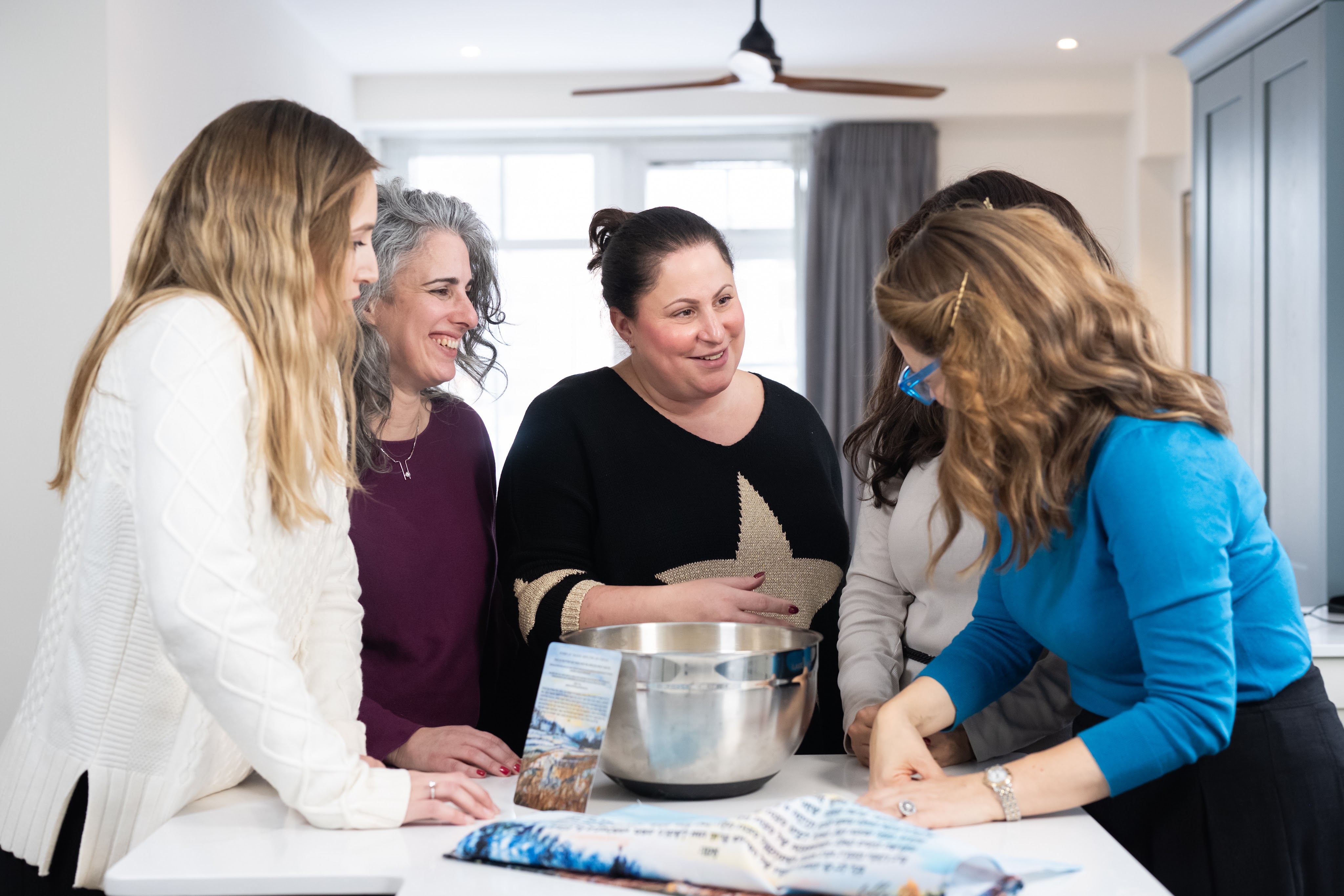
The image above is from our upcoming Hanukkah photo shoot, to me this is a group of women in their own way bringing light into the world, through prayer and friendship.
I don’t often comment on the week’s Torah portion. Not for any reason or resolve, but merely because I don’t often engage with it until Shabbat morning, at which time I’m often amazed at the ability of the Torah reading of the week to speak to the events of the day, often in unexpected ways. But after years of these coincidental meetings of ancient holy text with current affairs, I’m no longer surprised, and I take it in my stride, sharing lessons and insights where I can, with whomever will listen.
This week, I had occasion to get deeply involved in the Parasha (weekly Torah portion) in a way I haven’t in recent months. In this week’s portion, a lot happens, and so much of it is relevant to us. Jacob is about to cross into Israel and come face to face with his estranged brother Esau, with whom he fell out over the incident of the birthright. It seems that for Esau, the hatred and animosity have not diminished even though twenty-two years have passed. And Jacob is frightened; not that there won’t be a happy family reunion but rather that he is coming face to face with his death.
God, in his turn, tells Jacob not to worry, that He will look after him, that he will be safe, and that he will cross back into the Promised Land. And yet, Jacob is human, and he prepares for this meeting with Esau in three ways – he sends gifts in the form of flocks and cattle, he prays, and he divides his people into two camps (any of this sound familiar – trucks upon trucks of aid, days worth of tehillim being said, and our army is defending the North and the South). And then he stays behind alone. That evening he wrestles with a man. Is that man God himself, an angel, or really just a man? Regardless, this wrestling match is a seminal moment in Jacob’s story and in ours.
Jacob in Art
From Left: Top row: Francesco Fontebasso 1769, Italy. Eugène Delacroix 1861, France. Bottom Row: Peter Paul Rubens c. 1625. Marc Chagall 1963, France.


Jacob in Art
Jacob wins; the opponent asks Jacob his name. When a reply is offered, it is rejected, and Jacob is renamed ‘Israel,’ meaning ‘he who struggled with God and prevailed’. Israel. We are not named after Abraham or Isaac; we are named after Jacob.
The difference – Rabbi Sacks says – between Mozart and Beethoven is the difference between the forefathers and Jacob. As I am tone deaf, I use the example of Monet and Picasso. Monet’s art is beautiful, elegant; it seems to flow and fill you up with a graceful contentment. Picasso’s art is difficult and angular; not much makes sense. Both Monet and Picasso were undeniably geniuses; their art is celebrated the world over. Yet, no one is in doubt that Picasso’s art comes from a place of personal struggle. Jacob is Picasso; nothing is easy, everything is jagged and angular, everything he achieved he did through struggle, from the birthright to marrying his chosen bride, to the relationship with his wives and children. Every one of Jacob’s victories is hard-fought.
Though Abraham and Isaac are our patriarchs – we are named after Jacob. Though Sarah, Rebecca, and Leah are our other matriarchs, it is Rachel, Jacob’s beloved, who cries on the roadside waiting for her children to return. These forebears of ours are imperfect.
The wrestling match in which Jacob prevailed over the stranger, though he wins, is at a personal cost; for the rest of his life, he walked with a limp. Why, Rabbi Sacks asks, was Jacob so obviously punished? The answer was that he doubted himself. God told him to go to his brother Esau and not to worry; Jacob worried nonetheless, not because he didn’t trust in God but rather because he didn’t think himself good enough to merit God’s grace. That is what he is punished for. Though everything that Jacob did and achieved was hard-won, he was nonetheless born with the potential to do it; the only thing missing was his belief in his own ability. He made himself small when he was big; he made himself cower when he should have stood tall. Jacob was a man of faith who lost faith in his own ability.
The last seven weeks have made us all Jacob; for we were always Israel. But it has taken us back to the night before we wrestled with the man, before we prevailed. It has taken us back to the insecurity of not believing in ourselves.
I urge us all to look around at the thousands and tens of thousands, the hundreds of thousands of people who each have taken on a tiny bit of Jacob’s mantle, each stepping into the light, speaking the truth. Each one of those tiny pinpoints of light illuminates the dark. For we are the people who prevail, in the deepest darkest night, in the shadow of the valley of death, we reach for the summit. We, you and I, are Jacob. Am Israel Chai.

Now onto food!
Because we have to keep eating, feeding our bodies and our souls.
This past week, I had a very down moment – very down – and I gravitated to a place that I knew would calm the raging minions of despair: cutting vegetables. I know that, for myself, finally chopping vegetables requires total concentration. If I lose focus for a moment, I’m liable to lose a finger. And I needed my entire focus to shift from where it was to the mundane.
I chose to make Lentil Soup. Not only is it delicious, but there are a lot of vegetables to finely chop. Then, I made an Israeli salad – more vegetables to finely chop. All of this chopping means that for about 40 minutes, my mind had an opportunity to focus elsewhere – to alleviate some of the pain and pressure I was feeling. Bonus points for having food to eat at the end.


I also made the most stunning, delicious green tahini and herb salad platter . It is a platter flooded with green tahini, then topped with loads of fresh herbs that, though they require washing, checking, and then drying, was the perfect way to direct my focus. And then topped with loads of fresh vegetables and pita chips. It is really heavenly and, moreover, though I love making my own pita chips, unless you are going to eat the salad soon after the pita chips come out of the oven, you are better off topping the salad with store-bought ones.


The last recipe for this week is mujadara – rice with lentils. Being raised by an Israeli mother means my concept of soul food has very little to do with chocolate and ice cream (though I feel passionately about both), but when my soul needs to be fed, it will more often than not involve shed loads of fried onions. This is one of my family’s favorite recipes, and it is the onions that make all the difference. Modern-day legend has it that the bowl of lentil soup Esau sold his birthright for was actually Mujadara. Considering how delicious this dish is, I’m not surprised he sold his birthright for it.

